Pages

October 27, 2012

, ,

Where Does Technological Progress Lead – Ancient Greece or “Beggars in Spain”?

Ancient Greece
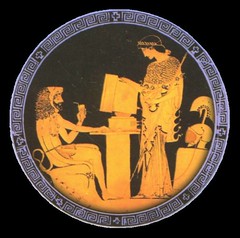
Ancient Greece (Photo credit: freeasinfreedom)

By zielonygrzyb

Ancient Greek polis are often thought to be the ideal form of participative democracy and vital cultural life of a society. Political discussions, philosophy, science and arts – male Greeks enjoyed a real “highlife” that many in the educated “elites” of today dream of. However, to engage in politics, arts, philosophy and science, one needs a significant amount of free time. Indeed, Greek vivid public life rested on a peculiar foundation: slaves. Greek citizens were free of doing most of the less pleasant (but necessary) work like washing, cleaning, production of simple everyday-use goods etc. Therefore they had lots of time to visit the Agora or the Amphitheatre.

Our society dismisses slavery as a violation of basic human rights. At the same time, ancient Greek highlife is still some form of an ideal to be pursued. So, are there other ways to achieve a state in which we could become the “new Greeks” (without enslaving anybody)? Indeed, one possibility comes to mind – technological progress. If it shall keep progressing at a pace similar to the historic productivity growth, at some point in not-so-far future we wouldn’t need to work much, too – machines would become the new slaves. But, however beautiful it may appear, this vision has many weak points, indeed.

First of all: there is no reason to assume that technological progress is going to take place forever. As Stephen DeCanio put it, “[t]he fact technological progress has been welfare-improving over humanity’s historical experience is an empirical observation, not a logical necessity.” Indeed, there are scholars (e.g. Robert Gordon) suggesting that what we in the rich parts of the world now count as technological progress (or productivity growth) is none in reality, that it has slowed down or even possibly stopped. Whether this is true or not (for the world as a whole it certainly isn’t), DeCanio’s statement remains true: if not today, productivity growth may cease any time soon.

But what would be if technological progress wouldn’t stop? Let us assume for the moment that it won’t cease before productivity increases as much as to enable us (potentially) to lead a life like that enjoyed by ancient Greeks – devoted to democratic participation, arts, philosophy and science. Even if we assume this, there is no guarantee that we shall wake up in computer-driven polis.

In 1993 Nancy Kress wrote an outstanding novel – Beggars in Spain. It is the first of 4 books describing a world where productivity growth has not ceased, which nevertheless in no way resembles ancient Greece. In Kress’s novel, the society is basically divided into two groups of citizens: the one is called “Donkeys”, the other “Livers” (there also are the “Sleepless”, but they are not important for our discussion). You may as well call them hosts and parasites. While the former commit their lives to work (they are, in a way, workaholics par excellence) and earning money (i.e., at the same time, paying taxes), the latter live off government social spending (funded by Donkey’s taxes), and they “live fast and die young” (engaging in sports, parties, rallies etc.). This would is, just as the “ancient Greece revisited” (see above) the result of very high productivity which makes it possible for a large part of the society (the “Livers”) to live off the labour of a working minority.

So, where does technological progress eventually lead? To ancient Greece or to a “Beggars in Spain” world? Or maybe to something entirely different? And is continuous technological progress possible at all? No-one can know the answers to these questions. However, when I look around, I see much more “Beggars in Spain” than Greek highlife. Maybe Greek highlife was only possible in a “dull” world bare TVs, Facebook, McDonald’s, shopping malls, Big Brother and X-Factor?

,

Greek Leadership in Thessaloniki To Celebrate Anniversary of City's Liberation From Ottoman rule


President of the Republic Karolos Papoulias and Prime Minister Antonis Samaras arrive in Thessaloniki on Friday for celebrations marking the 100th anniversary of the city's liberation from Ottoman rule. They attended a doxology in the morning at the church of Aghios Dimitrios (St. Demetrios), the city's patron saint, whose feast day is celebrated on October 26 (Friday). Afterwards they visited the Ministry of Macedonia-Thrace, where Papoulias inaugurated an exhibition of "Heirlooms of the Liberation 1912-1913" and "Celebration of the Flag: In the footsteps of the liberators", while Samaras and Macedonia-Thrace Minister Theodoros Karaoglou addressed the inauguration ceremony.

The October 28 "OXI Day" national holiday commemorates the anniversary of Greece's resounding "ochi" (no) to then Italian dictator Mussolini's demand for free passage to invade Greece during World War II, which brought Greece into the war on the Allied side. On Oct. 28, 1940, fascist Italy presented Greece with the ultimatum, but Greek leader Ioannis Metaxas tersely refused, and the country not only denied Mussolini's forces free passage, it went on the offensive in mid-November and drove the opposing forces back through part of southern Albania. The main military parade is traditionally held in Thessaloniki, while student parades are held in Athens and the rest of the country.

The three-day events in Thessaloniki marking the triple celebration of St. Demetrios' feast day, the 97th anniversary of the city's liberation from Ottoman rule, and the October 28 OXI Day national holiday.

On Saturday morning, Papoulias attended the Celebration of the Flat at the Thessaloniki Officers' Club, where he handed over the flat of the 100 years of the liberation of Thessaloniki and Macedonia to the head officer of local division of the Evzones (Presidential Guard), which was then be hoisted at the top of the White Tower.

On Sunday morning Papoulias will attend the military parade marking the October 28 OXI Day national holiday, after which he will depart for Athens. Defence minister Panos Panagiotopoulos, who is already in Thessaloniki where he will escort the President to the three-day events, is holding talks with the city authorities.

Also in Thessaloniki were Independent Greeks leader Panos Kammenos.
,

No Answers From FYROM To Greek Proposal

President Van Rompuy talks to Nikola Gruevski,...
(Photo credit: President of the European Council)
"Unfortunately there is no answer to Greece's proposal referring the continuation of the Nimetz procedure on the solution of the FYROM name issue," Foreign Ministry spokesman Grigoris Delavekouras said this past week. Replying to relevant queries, Delavekouras said that FYROM is displaying an attitude that disdains the UN procedures and adopts "offensive statements" on Greece, creating a climate that does not assist the procedures. Delavekouras underlined that a change of the climate is necessary, accusing FYROM of repetitive insults and offensive statements against Greece. On the EU report on enlargement, he reminded that it is only a proposal and only the EU member states' positions have substance. (AMNA)

Largest Greek Flag Ever Hoisted At Thessaloniki Port

English: A Greek flag waving. Ελληνικά: Μια ελ...
Greek national flag. (credit: Wikipedia)
The largest Greek flag ever was apparently hoisted at the port of Thessaloniki as part of the celebrations marking the 100th anniversary of the city's liberation from Ottoman Rule. The flag was donated to the municipality of Didimoticho by Zissis Chrysochoou. It measures roughly 480 square meters (or 17.46 meters by 27.52 meters) and weighs a whopping 130 kilos. Interestingly, the flag which has already been registered in the Guinness Book of Records as being the largest national flag in the world, was donated to the municipality of Didimoticho in 1998 for the celebrations marking the northeastern Greek town's liberation. (Article in Greek - newsnow)
,

DEMOCRACY NOW - Noam Chomsky : Who Owns the World? - VIDEO & Transcipt

Noam Chomsky
Cover of Noam Chomsky
In a recent speech, Chomsky examined topics largely ignored or glossed over during the presidential campaign: China, the Arab Spring, global warming, nuclear proliferation, and the military threat posed by Israel and the U.S. versus Iran. 

He reflects on the Cuban missile crisis, which took place 50 years ago this week and is still referred to as "the most dangerous moment in human history." 

He delivered this talk last month at the University of Massachusetts in Amherst at an event sponsored by the Center for Popular Economics. Chomsky’s talk was entitled "Who Owns the World?" (Source - Democracy  Now)


 Transcript -

    NOAM CHOMSKY: When I was thinking about these remarks, I had two topics in mind, couldn’t decide between them—actually pretty obvious ones. One topic is, what are the most important issues that we face? The second topic is, what issues are not being treated seriously—or at all—in the quadrennial frenzy now underway called an election? But I realized that there’s no problem; it’s not a hard choice: they’re the same topic. And there are reasons for it, which are very significant in themselves. I’d like to return to that in a moment. But first a few words on the background, beginning with the announced title, "Who Owns the World?"

    Actually, a good answer to this was given years ago by Adam Smith, someone we’re supposed to worship but not read. He was—a little subversive when you read him sometimes. He was referring to the most powerful country in the world in his day and, of course, the country that interested him, namely, England. And he pointed out that in England the principal architects of policy are those who own the country: the merchants and manufacturers in his day. And he said they make sure to design policy so that their own interests are most peculiarly attended to. Their interests are served by policy, however grievous the impact on others, including the people of England.

    But he was an old-fashioned conservative with moral principles, so he added the victims of England, the victims of the—what he called the "savage injustice of the Europeans," particularly in India. Well, he had no illusions about the owners, so, to quote him again, "All for ourselves and nothing for other people, seems, in every age of the world, to have been the vile maxim of the masters of mankind." It was true then; it’s true now.

    Britain kept its position as the dominant world power well into the 20th century despite steady decline. By the end of World War II, dominance had shifted decisively into the hands of the upstart across the sea, the United States, by far the most powerful and wealthy society in world history. Britain could only aspire to be its junior partner as the British foreign office ruefully recognized. At that point, 1945, the United States had literally half the world’s wealth, incredible security, controlled the entire Western Hemisphere, both oceans, the opposite sides of both oceans. There’s nothing—there hasn’t ever been anything like that in history.

    And planners understood it. Roosevelt’s planners were meeting right through the Second World War, designing the post-war world. They were quite sophisticated about it, and their plans were pretty much implemented. They wanted to make sure that the United States would control what they called a "grand area," which would include, routinely, the entire Western Hemisphere, the entire Far East, the former British Empire, which the U.S. would be taking over, and as much of Eurasia as possible—crucially, its commercial and industrial centers in Western Europe. And within this region, they said, the United States should hold unquestioned power with military and economic supremacy, while ensuring the limitation of any exercise of sovereignty by states that might interfere with these global designs.

    And those were pretty realistic plans at the time, given the enormous disparity of power. The U.S. had been by far the richest country in the world even before the Second World War, although it wasn’t—was not yet the major global actor. During the Second World War, the United States gained enormously. Industrial production almost quadrupled, got us out of depression. Meanwhile, industrial rivals were devastated or seriously weakened. So that was an unbelievable system of power.

    Actually, the policies that were outlined then still hold. You can read them in government pronouncements. But the capacity to implement them has significantly declined. Actually there’s a major theme now in foreign policy discussion—you know, journals and so on. The theme is called "American decline." So, for example, in the most prestigious establishment international relations journal, Foreign Affairs, a couple of months ago, there was an issue which had on the front cover in big bold letters, "Is America Over?" question mark. That’s announcing the theme of the issue. And there is a standard corollary to this: power is shifting to the west, to China and India, the rising world powers, which are going to be the hegemonic states of the future.

    Actually, I think the decline—the decline is quite real, but some serious qualifications are in order. First of all, the corollary is highly unlikely, at least in the foreseeable future. China and India are very poor countries. Just take a look at, say, the human development index of the United Nations: they’re way down there. China is around 90th. I think India is around 120th or so, last time I looked. And they have tremendous internal problems—demographic problems, extreme poverty, hopeless inequality, ecological problems. China is a great manufacturing center, but it’s actually mostly an assembly plant. So it assembles parts and components, high technology that comes from the surrounding industrial—more advanced industrial centers—Japan, Taiwan, South Korea, Singapore, the United States, Europe—and it basically assembles them. So, if, say, you buy one of these i-things—you know, an iPad from China—that’s called an export from China, but the parts and components and technology come from outside. And the value added in China is minuscule. It’s been calculated. They’ll move up the technology ladder, but it’s a hard climb, India even harder. Well, so I think one should be skeptical about the corollary.

    But there’s another qualification that’s more serious. The decline is real, but it’s not new. It’s been going on since 1945. In fact, it happened very quickly. In the late 1940s, there’s an event that’s known here as "the loss of China." China became independent. That’s a loss of a huge piece of the grand area of Asia. And it became a major issue in American domestic policy. Who’s responsible for the loss of China? A lot of recriminations and so on. Actually, the phrase is kind of interesting. Like, I can’t lose your computer, right? Because I don’t own it. I can lose my computer. Well, the phrase "loss of China" kind of presupposes a deeply held principle of kind of American elite consciousness: we own the world, and if some piece of it becomes independent, we’ve lost it. And that’s a terrible loss; we’ve got to do something about it. It’s never questioned, which is interesting in itself.

    Well, right about the same time, around 1950, concerns developed about the loss of Southeast Asia. That’s what led the United States into the Indochina wars, the worst atrocities of the post-war period—partly lost, partly not. A very significant event in modern history was in 1965, when in Indonesia, which was the main concern—that’s the country of Southeast Asia with most of the wealth and resources—there was a military coup in Indonesia, Suharto coup. It led to an extraordinary massacre, what the New York Times called a "staggering mass slaughter." It killed hundreds of thousands of people, mostly landless peasants; destroyed the only mass political party; and opened the country up to Western exploitation. Euphoria in the West was so enormous that it couldn’t be contained. So, in the New York Times, describing the "staggering mass slaughter," it called it a "gleam of light in Asia." That was the column written by James Reston, the leading liberal thinker in the Times. And the same elsewhere—Europe, Australia. It was a fantastic event.

    Years later, McGeorge Bundy, who was the national security adviser for Kennedy and Johnson, in retrospect, he pointed out that it probably would have been a good idea to end the Vietnam War at that point, to pull out. Contrary to a lot of illusions, the Vietnam War was fought primarily to ensure that an independent Vietnam would not develop successfully and become a model for other countries in the region. It would not—to borrow Henry Kissinger’s terminology speaking about Chile, we have to prevent what they called the—what he called the "virus" of independent development from spreading contagion elsewhere. That’s a critical part of American foreign policy since the Second World War—Britain, France, others to a lesser degree. And by 1965, that was over. Vietnam was—South Vietnam was virtually destroyed. Word spread to the rest of Indochina it wasn’t going to be a model for anyone, and the contagion was contained. There were—the Suharto regime made sure that Indonesia wouldn’t be infected. And pretty soon the U.S. had dictatorships in every country of the region—Marcos on the Philippines, a dictatorship in Thailand, Chun in South—Park in South Korea. It was no problem about the infection. So that would have been a good time to end the Vietnam War, he felt. Well, that’s Southeast Asia.

    But the decline continues. In the last 10 years, there’s been a very important event: the loss of South America. For the first time in 500 years, the South—since the conquistadors, the South American countries have begun to move towards independence and a degree of integration. The typical structure of one of the South American countries was a tiny, very rich, Westernized elite, often white, or mostly white, and a huge mass of horrible poverty, countries separated from one another, oriented to—each oriented towards its—you know, either Europe or, more recently, the United States. Last 10 years, that’s been overcome, significantly—beginning to integrate, the prerequisite for independence, even beginning to face some of their horrendous internal problems. Now that’s the loss of South America. One sign is that the United States has been driven out of every single military base in South America. We’re trying to restore a few, but right now there are none.

AMY GOODMAN: MIT Professor Noam Chomsky. Coming up, he discusses global warming, nuclear war and the Arab Spring, in a minute.
[break]

AMY GOODMAN: We’re on the road in Portland, Oregon, part of our 100-city tour. Today, though, we’re spending the hour with world-renowned political dissident, linguist, author, MIT Professor Noam Chomsky. As Election Day comes closer, Chomsky examines topics largely ignored or glossed over during the presidential campaign, including the threat posed to U.S. power by the Arab Spring.

    NOAM CHOMSKY: Well, moving on to just last year, the Arab Spring is another such threat. It threatens to take that big region out of the grand area. That’s a lot more significant than Southeast Asia or South America. You go back to the 1940s, the State Department recognized that the energy resources of the Middle East are what they called "one of the greatest material prizes in world history," a spectacular source of strategic power; if we can control Middle East energy, we can control the world.

    Take a look at the U.S-British coup in Iran in 1953. Very important event. Its shadows cast over the world until today. Now that was—it was a pretense that it was a part of the Cold War; it had nothing to do with the Cold War. What it had to do with was the usual fear: independent nationalism. And it wasn’t even concerned with access to oil or profits. It was concerned with control, control of the oil resources of Iran and, in fact, of the region. And that’s a theme that runs right through policy decisions. It’s not discussed much, but it’s very important to have control, exactly as State Department pointed out—advisers pointed out in the ’40s. If you can control the oil, you can control most of the world. And that goes on.

    So far, the threat of the Arab Spring has been pretty well contained. In the oil dictatorships, which are the most important ones for the West, every effort to join the Arab Spring has just been crushed by force. Saudi Arabia was so extreme that when there was an effort to go out into the streets, the security presence was so enormous that people were even afraid to go out. There’s a little discussion of what goes on in Bahrain, where it’s been crushed, but eastern Saudi Arabia was much worse. The emirates totally control. So that’s OK. We managed to ensure that the threat of democracy would be smashed in the most important places.

    Egypt is an interesting case. It’s an important country, not an oil producer—it is a small one. But in Egypt, the United States followed a standard operating procedure. If any of you are going into the diplomatic service, you might as well learn it. There’s a standard procedure when one of your favorite dictators gets into trouble. First, you support him as long as possible. But if it becomes really impossible—say, the army turns against him—then you send him out to pasture and get the intellectual class to issue ringing declarations about your love of democracy, and then try to restore the old system as much as possible. There’s case after case of that—Somoza in Nicaragua, Duvalier in Haiti, Marcos in the Philippines, Chun in South Korea, Mobutu in the Congo, over and over. I mean, it takes genius not to see it. And it’s exactly what was done in Egypt and what France tried to do, not quite with as much success, in Tunisia.

    Well, the future is uncertain, but the threat of democracy so far is contained. And it’s a real threat. I’ll return to that. It’s also to—important to recognize that the decline over the past 50 years is, to a significant extent, self-inflicted, particularly since the '70s. I'll go back to that, too. But first let me say a couple of things about the issues that are most important today and that are being ignored or not dealt seriously—dealt with seriously in the electoral campaigns, for good reasons. So let me start with the most important issues. Now there are two of these. They’re of overwhelming significance, because the fate of the species depends on them. One is environmental disaster, and the other is nuclear war.

    I’m not going to take much time reviewing the threats of environmental disaster. Actually, they’re on the front pages almost daily. So, for example, last week the New York Times had a front-page story with the headline, "Ending Its Summer Melt, Arctic Sea Ice Sets a New Low That Leads to Warnings." The melting this summer was far faster than was predicted by the sophisticated computer models and the most recent United Nations report. It’s now predicted that the summer ice might be gone by 2020. It was assumed before that it may be 2050. They quoted scientists who said this is "a prime example of the built-in conservatism of [our] climate forecasts. As dire [the warnings are] about the long-term consequences of heat-trapping emissions ... many of [us] fear [that] they may still be underestimating the speed and severity of the impending changes." Actually, there’s a climate change study program at MIT, where I am. They’ve been warning about this for years, and repeatedly have been proven right.

    The Times report discusses, briefly, the severe attack—the severe impact of all of this on the global climate, and it adds, "But governments have not responded to the change with any greater urgency about limiting greenhouse emissions. To the contrary, their main response has been to plan for exploitation of newly accessible minerals in the Arctic, including drilling for more oil." That is, to accelerate the catastrophe. It’s quite interesting. It demonstrates an extraordinary willingness to sacrifice the lives of our children and grandchildren for short-term gain, or perhaps an equally remarkable willingness to shut our eyes so as not to see impending peril—these things you sometimes find with young infants: something looks dangerous, close my eyes and won’t look at it.

    Well, there is another possibility. I mean, maybe humans are somehow trying to fulfill a prediction of great American biologist who died recently, Ernst Mayr. He argued years ago that intelligence seems to be a lethal mutation. He—and he had some pretty good evidence. There’s a notion of biological success, which is how many of you are there around. You know, that’s biological success. And he pointed out that if you look at the tens of billions of species in human—in world history, the ones that are very successful are the ones that mutate very quickly, like bacteria, or the ones that have a fixed ecological niche, like beetles. They seem to make out fine. But as you move up the scale of what we call intelligence, success declines steadily. When you get up to mammals, it’s very low. There are very few of them around. I mean, there’s a lot of cows; it’s only because we domesticate them. When you get to humans, it’s the same. 'Til very recently, much too recent a time to show up in any evolutionary accounting, humans were very scattered. There were plenty of other hominids, but they disappeared, probably because humans exterminated them, but nobody knows for sure. Anyhow, maybe we're trying to show that humans just fit into the general pattern. We can exterminate ourselves, too, the rest of the world with us, and we’re hell bent on it right now.

    Well, let’s turn to the elections. Both political parties demand that we make the problem worse. In 2008, both party platforms devoted some space to how the government should address climate change. Today, the—in the Republican platform, the issue has essentially disappeared. But the platform does demand that Congress take quick action to prevent the Environmental Protection Agency from regulating greenhouse gases. So let’s make sure to make it worse. And it also demands that we open the Alaska’s Arctic Refuge to drilling—I’m quoting now—in order to take "advantage of all of our American God-given resources." You can’t disobey God, after all. On environmental policy, the program says, "We must restore scientific integrity to our public research institutions and remove political incentives from publicly funded research." All that’s a code word for climate science: stop funding climate science. Romney himself says there’s no scientific consensus, so we should support more debate and investigation within the scientific community, but no action, except to act to make the problems worse.

    Well, what about the Democrats? They concede that there’s a problem and advocate that we should work toward an agreement to set emissions limits in unison with other emerging powers. But that’s it. No action. And, in fact, as Obama has emphasized, we have to work hard to gain what he calls a hundred years of energy independence by exploiting domestic or Canadian resources by fracking or other elaborate technologies. Doesn’t ask what the world would look like in a hundred years. So, there are differences. The differences are basically about how enthusiastically the lemmings should march towards the cliff.

    Let’s turn to the second major issue: nuclear war. That’s also on the front pages daily, but in a way that would seem outlandish to some independent observer viewing what’s going on on earth, and in fact does seem outlandish to a considerable majority of the countries of the world. Now, the current threat, not for the first time, is in the Middle East, focusing on Iran. The general picture in the West is very clear: it’s far too dangerous to allow Iran to reach what’s called "nuclear capability." That is, the capability enjoyed by many powers, dozens of them, to produce nuclear weapons if they decide to do so. As to whether they’ve decided, U.S. intelligence says it doesn’t know. The International Atomic Energy Agency just produced its most recent report a couple weeks ago, and it concludes—I’ll quote it: it cannot demonstrate "the absence of undeclared nuclear material and activities in Iran." Now, that is, it can’t demonstrate something which cannot—a condition that can’t be satisfied. There’s no way to demonstrate the absence of the work—that’s convenient—therefore Iran must be denied the right to enrich uranium, that’s guaranteed to every power that signed the Non-Proliferation Treaty.

    Well, that’s the picture in the West. That’s not the picture in the rest of the world. As you know, I’m sure, there was just a meeting of the Non-Aligned Movement—that’s large majority of the countries in the world and representing most of the world’s population—a meeting in Tehran. And once again, not for the first time, they issued a ringing declaration of support for Iran’s right to enrich uranium, right that every country has that signed the Non-Proliferation Treaty. Pretty much the same is true in the Arab world. It’s interesting. I’ll return to that in a moment.

    There is a basic reason for the concern. It was expressed succinctly by General Lee Butler. He’s the former head of the U.S. Strategic Command, which controls nuclear weapons and nuclear strategy. He wrote that "It is dangerous in the extreme that in the cauldron of animosities that we call the Middle East," one nation should arm itself with nuclear weapons, which may inspire other nations to do so. General Butler, however, was not referring to Iran; he was referring to Israel, the country that ranks highest in European polls as the most dangerous country in the world—right above Iran—and, not incidentally, in the Arab world, where the public regard the United States as the second most dangerous country, right after Israel. In the Arab world, Iran, though disliked, ranks far lower as a threat—among the populations, that is, not the dictatorships.

    With regard to Iranian nuclear weapons, nobody wants them to have them, but in many polls, majorities, sometimes considerable majorities, have said that the region would be more secure if Iran had nuclear weapons, to balance those of their major threats. Now, there’s a lot of commentary in the Western media, in journals, about Arab attitudes towards Iran. And what you read, commonly, is that the Arabs want decisive action against Iran, which is true of the dictators. It’s not true of the populations. But who cares about the populations, what are called, disparagingly, the Arab street? We don’t care about them. Now that’s a reflection of the extremely deep contempt for democracy among Western elites—I mean, so deep that it can’t be perceived. You know, it’s just kind of like reflexive. The study of popular attitudes in the Arab world—and there is very extensive study by Western polling agencies—it reveals very quickly why the U.S. and its allies are so concerned about the threat of democracy and are doing what they can to prevent it. Just take—they certainly don’t want attitudes like those I just indicated to become policy, while of course issuing rousing statements about our passionate dedication to democracy. Those are relayed obediently by reporters and commentators.

    Well, unlike Iran, Israel refuses to allow inspections at all, refuses to join the Non-Proliferation Treaty, has hundreds of nuclear weapons, has advanced delivery systems. Also, it has a long record of violence and repression. It has annexed and settled conquered territories illegally, in violation of Security Council orders, and many acts of aggression—five times against Lebanon alone, no credible pretext. In the New York Times yesterday, you can read that the Golan Heights are disputed territory, the Syrian Golan Heights. There is a U.N. Security Council resolution, 497, which is unanimous, declaring Israel’s annexation of the Golan Heights illegal and demanding that it be rescinded. And in fact, it’s disputed only in Israel and in the New York Times, which in fact is reflecting actual U.S. policy, not formal U.S. policy.

    Iran has a record of aggression. too. In the last several hundred years, it has invaded and conquered a couple of Arab islands. Now that was under the Shah, U.S.-imposed dictator with U.S. support. That’s actually the only case in several hundred years.

    Meanwhile, the severe threats of attack continue—you’ve just been hearing them at the U.N.—from the United States, but particularly Israel. Now there is a reaction to this at the highest level in the United States. Leon Panetta, secretary of defense, he said that we don’t want to attack Iran, we hope that Israel won’t attack Iran, but Israel is a sovereign country, and they have to make their own decisions about what they’ll do. You might ask what the reaction would be if you reverse the cast of characters. And those of you who have antiquarian interests might remember that there’s a document called the United Nations Charter, the foundation of modern international law, which bars the threat or use of force in international affairs. Now, there are two rogue states—United States and Israel—for whom—which regard the Charter and international law as just a boring irrelevance, so, do what they like. And that’s accepted.

    Well, these are not just words; there is an ongoing war, includes terrorism, assassination of nuclear scientists, includes economic war. U.S. threats—not international ones—U.S. threats have cut Iran out of the international financial system. Western military analysts identify what they call "weapons of finance" as acts of war that justify violent response—when they’re directed against us, that is. Cutting Iran out of global financial markets is different.

    The United States is openly carrying out extensive cyber war against Iran. That’s praised. The Pentagon regards cyber war as an equivalent to an armed attack, which justifies military response, but that’s of course when it’s directed against us. The leading liberal figure in the State Department, Harold Koh—he’s the top State Department legal adviser—he says that cyber war is an act of war if it results in significant destruction—like the attacks against Iranian nuclear facilities. And such acts, he says, justify force in self-defense. But, of course, he means only attacks against the United States or its clients.

    Well, Israel’s lethal armory, which is enormous, includes advanced submarines, recently provided by Germany. These are capable of carrying Israel’s nuclear-tipped missiles, and these are sure to be deployed in the Persian Gulf or nearby if Israel proceeds with its plans to bomb Iran or, more likely, I suspect, to try to set up conditions in which the United States will do so. And the United States, of course, has a vast array of nuclear weapons all over the world, but surrounding the region, from the Mediterranean to the Indian Ocean, including enough firepower in the Persian Gulf to destroy most of the world.

    Another story that’s in the news right now is the Israeli bombing of the Iraqi reactor in Osirak, which is suggested as a model for Israeli bombing of Iran. It’s rarely mentioned, however, that the bombing of the Osirak reactor didn’t end Saddam Hussein’s nuclear weapons program. It initiated it. There was no program before it. And the Osirak reactor was not capable of producing uranium for nuclear weapons. But, of course, after the bombings, Saddam immediately turned to developing a nuclear weapons program. And if Iran is bombed, it’s almost certain to proceed just as Saddam Hussein did after the Osirak bombing.

AMY GOODMAN: MIT professor and author, Noam Chomsky, continues in a moment. If you’d like a copy of today’s show, you can go to our website at democracynow.org. Professor Chomsky will next look at nuclear weapons race, as this week marks the 50th anniversary of the Cuban missile crisis, often referred to as "the most dangerous moment in human history." Back in a moment.

[break]

AMY GOODMAN: This is Democracy Now!, democracynow.org, The War and Peace Report. We’re on a 100-city tour, today in Portland, Oregon. I’m Amy Goodman, as we continue our hour today with world-renowned political dissident, linguist, author, and professor emeritus at the Massachusetts Institute of Technology, Noam Chomsky. His recent talk entitled "Who Owns the World?"

    NOAM CHOMSKY: In a few weeks, we’ll be commemorating the 50th anniversary of "the most dangerous moment in human history." Now, those are the words of historian, Kennedy adviser, Arthur Schlesinger. He was referring, of course, to the October 1962 missile crisis, "the most dangerous moment in human history." Others agree. Now, at that time, Kennedy raised the nuclear alert to the second-highest level, just short of launching weapons. He authorized NATO aircraft, with Turkish or other pilots, to take off, fly to Moscow and drop bombs, setting off a likely nuclear conflagration.

    At the peak of the missile crisis, Kennedy estimated the probability of nuclear war at perhaps 50 percent. It’s a war that would destroy the Northern Hemisphere, President Eisenhower had warned. And facing that risk, Kennedy refused to agree publicly to an offer by Kruschev to end the crisis by simultaneous withdrawal of Russian missiles from Cuba and U.S. missiles from Turkey. These were obsolete missiles. They were already being replaced by invulnerable Polaris submarines. But it was felt necessary to firmly establish the principle that Russia has no right to have any offensive weapons anywhere beyond the borders of the U.S.S.R., even to defend an ally against U.S. attack. That’s now recognized to be the prime reason for deploying missiles there, and actually a plausible one. Meanwhile, the United States must retain the right to have them all over the world, targeting Russia or China or any other enemy. In fact, in 1962, the United—we just recently learned, the United States had just secretly deployed nuclear missiles to Okinawa aimed at China. That was a moment of elevated regional tensions. All of that is very consistent with grand area conceptions, the ones I mentioned that were developed by Roosevelt’s planners.

    Well, fortunately, in 1962, Kruschev backed down. But the world can’t be assured of such sanity forever. And particularly threatening, in my view, is that intellectual opinion, and even scholarship, hail Kennedy’s behavior as his finest hour. My own view is it’s one of the worst moments in history. Inability to face the truth about ourselves is all too common a feature of the intellectual culture, also personal life, has ominous implications.

    Well, 10 years later, in 1973, during the Israel-Arab War, Henry Kissinger called a high-level nuclear alert. The purpose was to warn the Russians to keep hands off while he was—so we’ve recently learned—he was secretly informing Israel that they were authorized to violate the ceasefire that had been imposed jointly by the U.S. and Russia. When Reagan came into office a couple of years later, the United States launched operations probing Russian defenses, flying in to Russia to probe defenses, and simulating air and naval attacks, meanwhile placing Pershing missiles in Germany that had a five-minute flight time to Russian targets. They were providing what the CIA called a "super-sudden first strike" capability. The Russians, not surprisingly, were deeply concerned. Actually, that led to a major war scare in 1983. There have been hundreds of cases when human intervention aborted a first-strike launch just minutes before launch. Now, that’s after automated systems gave false alarms. We don’t have Russian records, but there’s no doubt that their systems are far more accident-prone. Actually, it’s a near miracle that nuclear war has been avoided so far.

    Meanwhile, India and Pakistan have come close to nuclear war several times, and the crises that led to that, especially Kashmir, remain. Both India and Pakistan have refused to sign the Non-Proliferation Treaty, along with Israel, and both of them have received U.S. support for development of their nuclear weapons programs, actually, until today, in the case of India, which is now a U.S. ally.

    War threats in the Middle East, which could become reality very soon, once again escalate the dangers. Well, fortunately, there’s a way out of this, a simple way. There’s a way to mitigate, maybe end, whatever threat Iran is alleged to pose. Very simple: move towards establishing a nuclear-weapons-free zone in the Middle East. Now, the opportunity is coming again this December. There’s an international conference scheduled to deal with this proposal. It has overwhelming international support, including, incidentally, a majority of the population in Israel. That’s fortunately. Unfortunately, it’s blocked by the United States and Israel. A couple of days ago, Israel announced that it’s not going to participate, and it won’t consider the matter until there’s a general regional peace. Obama takes the same stand. He also insists that any agreement must exclude Israel and even must exclude calls for other nations—meaning the U.S.—to provide information about Israeli nuclear activities.

    The United States and Israel can delay regional peace indefinitely. They’ve been doing that for 35 years on Israel-Palestine, virtual international isolation. It’s a long, important story that I don’t have time to go into here. So, therefore, there’s no hope for an easy way to end what the West regards as the most severe current crisis—no way unless there’s large-scale public pressure. But there can’t be large-scale public pressure unless people at least know about it. And the media have done a stellar job in averting that danger: nothing reported about the conference or about any of the background, no discussion, apart from specialist arms control journals where you can read about it. So, that blocks the easy way to end the worst existing crisis, unless people somehow find a way to break through this.

AMY GOODMAN: MIT Professor Noam Chomsky spoke on September 27th of this year at the University of Massachusetts in Amherst. His talk was entitled "Who Owns the World?"
Enhanced by Zemanta

October 26, 2012

, , ,

WOW - Levant Basin Boasts 122trln In Natural Gas - Cyprus Builds Up Role In East Mediterranean

MODIS satellite image of Cyprus.
MODIS satellite image of Cyprus. (Photo credit: Wikipedia)
Situated in waters between Israel, Lebanon, Syria and Cyprus, the Levant Basin boasted an estimated 122 trillion cubic feet of natural gas, offering a path to energy independence for much of the region. However, located at deep and precarious depths, the gas remains a costly investment. Nonetheless, Levant offers Cyprus access to an estimated 5.1 trillion cubic feet of natural gas within the country’s Exclusive Economic Zone

Building on its new role as the Eastern Mediterranean’s natural gas anchor, Cyprus announced a new working partnership with Egypt meant to promote the sharing of expertise and experience between the two countries. According to comments from Egyptian Minister of Petroleum and Mineral Resources, Ossama Kamal, Cyprus made an appeal for guidance on how best to approachthe island-nation’s new-found oil and gas claims in the region. A Cypriot technical delegation is scheduled to travel to Egypt next month, according to the Egypt Daily News.

Recently, Cyprus has emerged as one of the most active actors in the push to exploit the Eastern Mediterranean’s newfound energy potential. The country’s European backing and apparent willingness to explore production partnerships with just about anyone have allowed them to etch out a reliable middle ground in the often-contentious energy environment. As Israel, Lebanon and Turkey deal with conflicting claims over the regional find and maritime, Cyprus appears content to extend an olive branch to all in the region.

To be sure, leaders in Nicosia have encountered some blowback for their efforts, most notably in the form of Turkish naval ships sent to express the country’s strong feelings about Northern Cyprus being left out of the energy boom. But even then, Cyprus responded with an open-arms approach, suggesting that gas revenues from local exploration could be used to fund reunification talks between the island’s two halves.

For their part, Egypt may view this new partnership with Nicosia as a potential path into a regional energy boom they’ve been locked out of until now – the Levant Basin. 

Situated in waters between Israel, Lebanon, Syria and Cyprus, the Levant Basin boasted an estimated 122 trillion cubic feet of natural gas, offering a path to energy independence for much of the region. However, located at deep and precarious depths, the gas remains a costly investment. Only Cyprus and Israel have made real progress towards exploiting the reserves and even now, the cost of securing operations in such a highly contentious environment could prove challenging for Tel Aviv. Turkey has announced plans to begin exploration efforts of the coast of North Cyprus, but progress remains uncertain.

This environment has left Cyprus as the willing middleman between the region’s many interested parties.

“The strategic position of Cyprus in the Mediterranean Sea, in conjunction with the recent gas discoveries in the region and plans for their export, could prove an alternative and fully flexible gas storage hub for the European Union and the rest of the world”, Industry and Tourism Neoklis Sylikiotis recently said during a speech to the European Oil & Gas Summit, according to a government release.

In addition to the new agreement with Egypt, Cyprus has established ties with Israel, including exploring the possibility of hosting refining, transport and Liquefied Natural Gas facilities that the Israeli government would rather not have around.

For its own part, the Levant offers Cyprus access to an estimated 5.1 trillion cubic feet of natural gas within the country’s Exclusive Economic Zone. According to Reuters, the country’s Industry and Tourism minister Neoclis Sylikiotis suggested they would be able to meet domestic needs with local natural gas by 2017 and earn export revenue by 2019. Having reported the natural gas find just this past December, Cyprus moved quickly to exploit the claim by asking for bids in May. The response from foreign firms, including Total and Italy’s Eni, amounted to 15 bids across 9 blocks. Russian firms also chimed in with support, reflecting urgency on the part of the country to support Cyprus through its current economic crisis. According to Bloomberg, Russians make up a large percentage of the non-residents in Cyprus who hold one of every two euros deposited in the country’s banks.

To be clear, any new energy role the island nation could take on is unlikely to help them out of their immediate fiscal ditch. Facing a enormous deficits and losses thanks to their exposure to Greek sovereign debt, Cyprus will most certainly need more than the $12.4 billion its creditors and potential lenders now believe they need. That’s going to take a while and by no means will it be pleasant.

While Cyprus’ open-armed approach has worked so far, their new partnership with Egypt could prove difficult to sustain alongside their cooperation with Israel, especially if Cairo expands their current offshore efforts towards already contested waters. In the months since the collapse of the government of Hosni Mubarak, ties between Egypt and Israel have been increasingly strained, due mostly to natural gas agreements. After Mubarak was removed from power, records emerged showing below market prices for a 20-year gas agreement with Israel and allegations of further corruption with the ousted president’s administration. This tension was accompanied by 15 attacks on pipelines from Egyptian fields to Israel, who looked west for 35 to 40 percent of their natural gas needs. The situation continued to sour until gas sales to Israel were finally cancelled.

http://www.forbes.com/sites/christophercoats/2012/10/24/cyprus-extends-east-med-gas-role-with-egyptian-deal/
http://geopolitics-gr.blogspot.gr/2012/10/cyprus-extends-east-med-gas-role-with.html
,

17 Year Old Greek student wins the First prize Of Young Scientists in Engineering


Congratulations to 17 year-old Charalampos Ioannou, a Greek student who won first prize at this year's European Union Contest for Young Scientists. His scientific field was engineering and his project entitled ‘Device which enhances and supports the movement of the human palm’

The European Union Contest for Young Scientists (EUCYS) is an initiative created by the European Commission in 1989 with a goal of promoting the science interchange between young scientists and guiding them to a future in science and technology. The event is an annual contest and exhibition of the finest work developed in many scientific fields; the best young minds of different countries can compare ideas and admire each other's work.

After being awarded with the first prize, Charalampos said his goal was to construct a device that will support and assist the movement of the human hand. "In order to achieve this, we need to detect the force that one applies to an object, by the use of pressure sensors. After this, a processing system will process the received data from the sensors and according to the values received; it will move respectively servo motors, which are installed in an exoskeletal metal glove. The strength of the operator is enhanced in this way."

Bravo Palikari mou... Athanatoi Ellada!


, , , ,

SYRIZA Leader Meets With President Of SAE

English: Alexis Tsipras in a press conference ...
Alexis Tsipras (credit: Wikipedia)
The Greek people need unity, determination, and a political leadership that will inspire the collective vision, and not terrified leaderships that cannot rise to the circumstances, main opposition SYRIZA leader Alexis Tsipras said Wednesday, commenting on the statements by Prime Minister Antonis Samaras, PASOK leader Evangelos Venizelos and Democratic Left (DIMAR) leader Fotis Kouvelis after Tuesday's meeting of the leaders of the three parties supporting the coalition government.

In a statement Wednesday after a meeting with Council of Hellenes Abroad (SAE) president Stephanos Tamvakis, Tsipras said that the country must reject the perpetual economic supervision by "those who want to render the country a debt colony", adding that Greece is already facing an unprecedented crisis, an economic and social disaster it has never seen before except after war.

Tsipras praised the SAE and its efforts to help the Greek people and attract serious investors to Greece, while at the same time supporting the new immigrants leaving the country in search of a better fate. The two men discussed the losses suffered by Greeks abroad who had purchased Greek sovereign bonds, due to the haircut of the Greek debt and the PSI, adding that this showed the unreliability of the Greek state. (AMNA)

Editor's Note - His meeting with SAE does not surprise us one bit. We are certain that his benefactor Mrs. Angelopoulou is very pleased... her investment is doing well. Small Qiuz: Exactly who is SAE representing abroad? Investors... or Greeks? Because if they were representing Greeks, then they would be in Washington rallying against the FYROM and Turkish lobbies. Also, they would be accessible to all Greeks in the Diaspora and not just a selected few. Finally, this organization would not be meeting with the political elite of Greece, instead it would be having one to one sessions with Greek Diaspora organizations on how to bring Greeks of the Diaspora closer to Hellas. HellasFrappe once believed strongly in this organization, but we changed our opinion of them with the passing of time because we have never seen and/or experienced any of their work. We also suspect that they worked closely with George Papandreou and the PASOK party in 2009 -according to the Kalami newspaper- in order to vote against the voting rights law that former Prime Minister Costas Karamanlis had tabled in the Greek Parliament. As some may remember, PASOK voted against this law in fear that the Diaspora -which is mostly conservative- would vote against them. AHEPA is another such organization. Although it has donated money to various Greek charities, it hasn't really done any substantial work on Greek national issues. That is why it does not surprise us one bit that Tsipras, met with them... its like watching the same old story again.
 

"Nutty" Facts About Chestnuts From Ancient Times To Present

There are flavors and aromas that bring back many memories to Greek people during the autumn to winter season, especially when the first rains set in, or the first snowfalls begin freezing the earth. One such vivid image is the chestnut roaster, or the "Kastana".

The art of chestnut roasting is one of the few traditional professions that did not perish with the passing of time. Men usually tackled this profession in Greece, although today many women also dabble with the roasting. Their work usually begins in the mid Autumn and runs all the way till the very first days of Spring.

Specifically, when the rain season begins (mid October) the Kastana (or the Chestnut Roaster) prepares the Foufou. The Foufou - a northern Greek word- is a mobile oven that is round and separated in three areas. (Guess this is why we say fou, fou when we blow out the candles.)

The Kastana usually slightly cuts the chestnuts on one side and then throws them into this oven until they are done. The Kastana then sets up shop at some corner on a busy street and begins to sell his goods.

Ahh... the aromas.

Young and old, no one can resist a bag of warm and toasted chestnuts from the neighborhood Kastana.


History

In ancient times, the chestnut tree was regarded as the tree of Zeus. In fact on Mount Olympus our ancient ancestors apparently had an abundance of chestnut trees producing this sweet, edible nut and they included it in many of their dishes. One such dish was the first pizza. Yes, you read correctly, the first pizza was created in Greece out of chestnut flour.

Alexander the Great and the Romans planted Chestnut trees across Europe while on their various campaigns. The Greek army is said to have survived their retreat from Asia Minor in 401-399 B.C. thanks to their stores of chestnuts. Ancient Greeks like the physician, pharmacologist and botanist Dioscurides and Romans such as Galen, the prominent physician and philosopher of Greek origin, wrote of chestnuts to comment on their medicinal properties.


Festivals

Since then chestnut season is celebrated every year throughout the Greek countryside with special events that are organized by local communities to help promote this scrumptious product as well as endorse its nutritional value.

Most events run through mid-October up to mid-November. In such a context, the 9th annual chestnut festival in Laconia is scheduled be held between October 26-28 in the village of Arna. The three-day festival features artistic events and an outdoor market where visitors may purchase lots of autumn produce from the local farmers, and obviously chestnuts.

Further north in the Peloponnese and specifically in the Arcadian mountainous village of Kastanitsa another festival will be held.

Other chestnut festivals include: A festival in Paleochori in the Kavala prefecture (N.Greece), Damaskinia in the prefecture of Kozani, Agiasos on the island of Lesvos and Karitsa in the prefecture of Larissa.


Valuable nutrients

Chestnuts, unlike other nuts and seeds, are relatively low in calories; contain less fat but are rich in minerals, vitamins and phyto-nutrients that benefit health. Nutritionally, chestnuts possess almost similar nutrition composition as that of other staple foods such as sweet potato, sweet corn, potatoes etc, consisting mainly of starch. However, the nuts also contain high quality protein. They are good source of dietary fiber; provides 8.1 g (about 21% of RDI) per 100 g. Fiber diet helps lower blood cholesterol levels by remove excess cholesterol absorbing in the intestines.

Chestnuts stand out from other nuts and seeds because of their nutrition contents. They are exceptionally rich in vitamin-C. 100 g nuts provide 43 mg of vitamin C (72 % of DRI). Vitamin C is essential for formation of matrix in teeth, bones and blood vessels. Being a strong anti-oxidant, it offers protection from harmful free radicals. They are the one of the nuts rich in folates. 100 g nuts provide 62 mg of folates (or 15.5%). Folic acid is required for the formation of red blood cells, DNA synthesis. Adequate consumption of food rich in folates during peri-conception period helps prevent neural tube defects in the fetus.

They are rich source of mono-unsaturated fatty like oleic acid (18:1) and palmitoleic acids (16:1). Studies suggest that monounsaturated fats in the diet help lower total as well as LDL (bad cholesterol) and increase HDL (good cholesterol) levels in the blood. Mediterranean diet which is rich in dietary fiber, monounsaturated fatty acids, omega fatty acids and antioxidants help prevent coronary artery disease and strokes by favoring healthy blood lipid profile.

The nuts are excellent source of minerals such as iron, calcium, magnesium, manganese, phosphorus and zinc. They provide very good amount of potassium (518 mcg / 100 g). Potassium helps counter hypertensive action of sodium, lowers heart rate and blood pressure. Iron helps prevent microcytic-anemia. Magnesium and phosphorus are important components of bone metabolism. They are also rich in many important B-complex groups of vitamins. 100 g of nuts provide 11% of niacin, 29% of pyridoxine (vit.B-6), 100% of thiamin, and 12% of riboflavin.

Chestnuts, like hazelnuts and almonds, are free in gluten and therefore popular ingredient in the preparation of gluten free food formulas for gluten-sensitive, wheat allergy and celiac disease persons.


More "Nutty" Facts
  • When buying chestnuts you should note the following points: They should have a smooth and glossy surface. They should be quite hefty relatively to their small size. If they make noise when you dangle them in your hands, this is an indication that they have dried up and therefore are not particularly fresh.
  • Fresh chestnuts should be eaten within a week, if of course they have been stored at room temperature (always in a dry, dark, cool place). If you want your chestnuts to last longer you can do so by placing them in your refrigerator in a plastic bag that you perforated in order to get aired, this way they can last up to a month. If you want them to last longer then you can put them in your freezer. This way they can last up to three or four months.
  • Chestnuts already scalded and cleaned, should be eaten within 3-4 days, because easily form mold. In these state they can be preserved in the freezer for up to 9 months!
  • This is the color called chestnut in Crayola crayons. This color was also produced in a special limited edition in which it was called Vermont maple syrup. At the request of educators worried that children (mistakenly) believed the name represented the skin color of Native Americans, Crayola changed the name of their crayon color Indian Red to Chestnut in 1999.
  • Chestnuts , including the chinkapins, are a genus of eight or nine species of trees and shrubs in the beech family Fagaceae. The name also refers to the nuts produced by these trees. Most are tall trees to 30-40 m tall, but some species (the chinkapins) are shrubby. 


If you plan on roasting some Chestnuts at home then follow these easy steps:
  • Cut a little “X” mark in the top part of the shell to prevent them from exploding in the oven – BE CAREFUL NOT TO CUT YOURSELF!
  • Soak the chestnuts in cool water for about 20 minutes.
  • While the chestnuts are soaking, preheat your oven to 400* F
  • Pull the nuts from the water, dry them with a towel, and place them on a baking sheet pan with the “X”  mark facing up.
  • Roast the chestnuts for 20 minutes, then let rest for 5 minutes before pealing. THEY’RE STEAMING HOT WHEN DONE!
  • Peal them and enjoy!

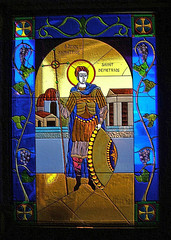
Great-martyr Saint Demetrius of Thessaloniki

St. Demetrios of Thessaloniki
St. Demetrios of Thessaloniki (credit: Tony Fischer Photography)


Special thanks From HellasFrappe To our friends at the Orthodox Breath blog for this article

The holy, glorious and right-victorious Great-martyr (Greek: Μεγαλομάρτυς) Demetrius (Dimitrios, or Demetrios) of Thessaloniki the Myrrh-streamer (Greek Μυροβλήτης), is one of the most popular saints in the Orthodox world. He was martyred sometime in 306 AD in Thessaloniki (capital of Macedonia region in Greece), and his cult rapidly grew during the Middle Ages, when he was regarded as the first recognized as the patron and protector of the city, militarily as well as spiritually. His feast day is celebrated on October 26.

Demetrius came from a noble family of the Roman province of Macedonia. Through this noble ancestry and through his own ability and virtue he rose to a high military position under Galerius Maximian, Caesar of the Eastern part of the Roman Empire (with Diocletian as the Augustus, or senior emperor). Despite this position in the still-pagan empire, he remained fervent in faith and works for Christ, encouraging many Christians to endure persecution and even bringing many pagans to the faith.
When Maximian returned from one of his campaigns to Thessaloniki, which he had made his capital, he had pagan games and sacrifices celebrated for his triumph.

Demetrios was denounced by pagans who were envious of his success, and he was thrown into prison. While in prison he was visited by a young Christian named Nestor, who asked him for a blessing to engage in single combat with the giant Lyaios (or Lyaeus), who was posing as the champion of paganism. Demetrios gave his blessing and Nestor, against all odds, slew his opponent in the arena, as David had once defeated Goliath.

The enraged emperor, learning that this had occurred with Demetrios's aid, first had Nestor beheaded outside the city and then had Demetrios impaled in prison. Later Demetrios's servant Lupus was beheaded after using his master's blood-stained tunic and signet ring to work many miracles. The Christians buried Demetrius and Nestor next together in the bath where Demetrius had been imprisoned. During the seventh century a miraculous flow of fragrant myrrh was found emanating from his tomb, giving rise to the appellation Mirovlitis, the Myrrh Gusher to his name. His tomb containing his relics is now in the crypt of the Church of St. Demetrios in Thessaloniki.

St. Demetrius is revered as the patron saint of Thessaloniki and is believed by the people as having intervened to save the city over the years from invading foreigners, from the Slavic nations, Bulgarians, Arabs, Saracens, and others. While well remembered in the Hellenic world, the memory of the Great Martyr Demetrius of Thessaloniki found an attachment in the Slavic, particularly the Russian, world from the times of the Russian Primary Chronicle.

Popularity in the sixth century

Extreme popularity for Saint Demetrios is first attested in the sixth century. It grew because of his miraculous interventions in defense of the city during the many sieges it endured during the early Middle Ages, particularly by Slavic tribesmen who overran the old provinces of Hellas(Greece) and Macedonia during the sixth through eighth centuries. His cult was centered around the basilica that bears his name in Thessaloniki, which contained a ciborium which acted as a cenotaph, since his relics had not been found. Later his relics were found and confirmed through their miraculous outpouring of myrrh -- hence the saint's epithet of "Myrrh-streamer."

He is depicted in earlier images in civilian aristocratic garb of the late Roman Empire, and in later iconography as a Byzantine soldier. Because of his military protection he is often paired with St. George of Cappadocia, another great military saint. They are usually depicted on horseback, with St. Demetrios spearing a man (perhaps Lyaios, or one of the pagan Slavs whose assaults he warded off from his city), while St. George spears a dragon. The saints are both youthful and unbearded, by can be distinguished by certain characteristics, including hair style and the colors of their garments and horses.

Nestor, Demetrios's protégé, is commemorated the day after Demetrios, on October 27.
, ,

Members of the Greek-Albanian Himara Region In Favor of Autonomy

Road on the mountains of the National Park of ...
Road on the mountains of the National Park of Llogara looking down on the village of Dhërmi, Himara, Albania (credit: Wikipedia)

In a recent public opinion poll, conducted by the SManalysis blog, members of the Himara Community in Albania (Voreioipirotes) as well as Diaspora in the US and Europe are apparently in favor of an Independent Himara Region, or separating their region from Albania.

In total 38% of those polled said that they were in favor of an independent Himara region, 36% said they believed that Himara should be remain in Albania, 24% said that the region should once again return to Greece, and only 2% said that it should once again become one with the region of Epirus in northern Greece.

(Reference - smarkos)

, ,

GOOD NEWS - Greek Gov't Working On New Diaspora Vote Law

Greeks in NY July 4th parade
Greeks in NY (credit: Wikipedia)
While addressing the Special Committee on Greeks Abroad at the Greek parliament on Thursday, Minister of Interior Evripides Stylianides noted the importance of FINALLY granting voting rights to Greek Diaspora. The Minister explained that he believes the bickering between political parties will be set aside to find a solution, although all previous efforts to find a compromise had failed.

According to Stylianides, the Ministry has already assigned a working group to process a draft law mainly focusing on the right of Greeks living abroad to vote, equality in voting rights, reliability of the procedure, administrative preparedness and a low cost for the project. Once the draft law is ready, it will be ready for public debate in order for the parties to make their amendments before it heads to Parliament.

The Minister also underlined that the Diaspora constitutes an important Hellenic presence outside the country’s borders, which makes it imperative to pass the right to vote. Referring to articles of the Greek Constitution and a decision against Greece issued by the European Court of Human Rights, Stylianides said that only Greece and Ireland refuse their Disapora the right to vote.

Editor's Note - WE ARE VERY, VERY PLEASED with this development. We cannot begin to describe our relief and we really hope that the government does not let us down for yet another time. For the past 10 years the Editor of HellasFrappe has rallied and worked very hard so that Greeks in the Diaspora can finally be granted voting rights. For this she connected with Greek organizations -of a global nature- but to no avail. She aligned herself and worked for a magazine dedicated to the Diaspora, but again, to no avail. She even spoke in political groups and complained to State officials, but no one would listen to her. And now her position on this issue is finally being vindicated and the feeling of justification cannot be placed into words. The mere fact that the Greek government -as Costa Karamanlis' gov't did as well- recognized the importance of the Greek Diaspora, is VERY significant. The news is indeed very positive, and very encouraging. Now that the Greek government has paved the road, and is finally going to grant us the one right we are entitled to because of our origin, it is time for us to also begin discussing and rallying for a better leadership within the ranks of our Diaspora organizations -who until now have been inactive on anything that is Greek related-. We believe their work is complete. In our opinion it has not been as effective as we would of wanted it to, and we also believe that it is time for all these people to step down and allow young, bright minds to step forward that will take our Diaspora into the next generation with only Hellas on their mind. 


How the Illuminati is Reordering the Middle East

by Richard Evans
henrymakow.com

In 1997, a group of Republicans formed a non-profit organization called the Project For A New American Century (PNAC). In their first white paper, Rebuilding America's Defenses, they proposed taking down Saddam Hussein, Iraq and then reordering the entire Middle East. Parenthetically, they admitted that selling such plans to the American people would take a long time, "absent some catastrophic catalyzing event like a new Pearl Harbor." (p.51)

September 11, 2001 was obviously just what they had in mind.

In 2000, the US Supreme Court selected another Bush as the 43rd US President and he waited until 9/11 to begin reordering the world.

In that connection, in March 2007, retired General Wesley Clark told Amy Goodman on her Democracy Now TV program that as early as September 2001, the Pentagon already had plans to take down seven Islamic countries, Iraq, Syria, Lebanon, Libya, Somalia, Sudan and Iran. If you have not seen the short You Tube of General Clark's revelations on Democracy Now, it is worth watching

At that time, I was skeptical about such a large US Military operation, because we all knew The Bush Administration lied us into Iraq with phony stories of Weapons of Mass Destruction, yellowcake uranium, mobile biological weapons labs, etc.

In 2007, the US Military only occupied Afghanistan and Iraq, so I asked myself, "How will The White House justify the military cost to the American people of invading Syria, Lebanon, Libya, Somalia, Sudan and Iran?"

By 2011, the answer became clear. The unnecessary wars against Syria, Lebanon, Libya, Somalia and Sudan would be staged covertly as irregular military coups with the US Military and CIA supporting PHONY democracy movements.

Remember the baloney about 'Arab Spring' and the spontaneous 'Twitter' revolutions supporting "civil unrest" in Egypt, Tunisia and Libya? Was the US behind these civil wars and bogus democracy movements?

Remember 2011 when Libyan Al-Qaeda could not budge Gaddafi's Libyan Army, the US and NATO enforced a NO Fly Zone over Libya and launched hundreds of cruise missiles in support of Al-Qaeda and the rebels.

By Oct 20, 2011 Muammar Gaddafi was a deadman and Libya was a war torn shattered nation. But no one in America feels the least bit guilty about America's role in trashing Libya. Most people believe these events were spontaneous democratic revolutions. Doesn't anyone remember the PNAC's plans to reorder the Middle East?

GADDAFI RESISTANCE KILLED US AMBASSADOR

In Libya last month, we lost Ambassador Steven in an attack on the US Consulate in Benghazi. The press wants us to think that we brought "freedom and democracy" to Libya, not chaos and death. They want us to believe that there is no Green Resistance to the NATO or its Al-Qaeda allies in Benghazi, but everyone in Libya knows about the Green Resistance, whose members are called "Tahloob" (Arabic for "Gaddafi loyalists").

In reality, the Green Resistance destroyed the US Consulate in Benghazi September 11, 2012. They have been increasingly active since shortly after the murder of Muammar Gaddafi in October 2011. They strike any NATO target they can, and they execute key Libyans who betrayed Gaddafi and sided with NATO. The Benghazi incident was merely their latest blow against what they see as NATO's illegal occupation of their country. Ignoring the Tahloob only happens outside of Libya, by the NATO powers and their subservient media.

In Egypt, President Mohamed Morsi of the radical Muslim Brotherhood replaced moderate Hosni Mubarak, yet the civil unrest in Egypt continues.  While Obama and Romney trade accusations about whether The Obama Administration was guilty of leaving the grounds of the Benghazi Consulate vulnerable, THERE IS NO SERIOUS DISCUSSION REGARDING WHETHER THE US MILITARY SHOULD SUPPORT THESE PHONY REVOLUTIONS IN THE FIRST PLACE.

WAGING WAR WITHOUT PERMISSION

What is even more disturbing is the US Congress is side-stepping its US Constitutional duty to declare war, but the press ignores their failure too. The CIA shouldn't decide whether we go to war. The US Congress should debate and decide, so Congressmen can be responsible to the American people come election time.

There is a Constitutional debate in America regarding whether Obama is in violation of the War Power Act in regard to Libya, BUT THE MEDIA IGNORES THIS VIOLATION.

"May 20, 2011, marked the 60th day of US combat in Libya (as part of the UN resolution) but the deadline arrived without President Obama seeking specific authorization from the US Congress. President Obama, however, notified Congress that no authorization was needed, since the US leadership was transferred to NATO, and since US involvement is somewhat limited. On Friday, June 3, 2011, the US House of Representatives voted to rebuke President Obama for maintaining an American presence in the NATO operations in Libya, which they considered a violation of the War Powers Resolution." http://en.wikipedia.org/wiki/War_Powers_Resolution

So how is this reordering of the Middle East progressing? Friday, October 19, 2012, a huge car bomb in a Christian Beirut neighborhood killed Lebanon's security chief, General Wissam al-Hassan along with seven others and wounding eighty or more people. Two days after that, a similar car bomb ripped through the Christian Old Town of Damascus. Two days later, Tuesday, October 23, three car bombs in Baghdad killed nine people and wounded 26. If anyone seriously wonders WHO WOULD DO SUCH AWEFUL THINGS? -- they should recall the PNAC's plans and Wesley Clark's revelations to Amy Goodman.

October 25, 2012

, , ,

Lagarde List A La "Imia": Greek Secret Services Found It - Venizelos & Papakostantinou Buried It!

Greek politician Giorgos Papakonstantinou on S...
G. Papakonstantinou (Photo credit: Wikipedia)
Now that more details are being brought to light, it would be fair to point out that the alleged Lagarde list was actually discovered by Greece's National Intelligence Agency (EYP), who found the list and then gave it to George Papandreou's government.

There is an old saying that claims, that when people forget their history, it is bound to repeat itself. And because people have indeed forgotten about the incident at Imia and what happened before, during and after that night, (which almost resulted in a heated Greek-Turkish confrontation) we here at HellasFrappe felt the need to remind them. When the Greek intelligence agency discovered that a provocation would be staged that historical night by Turkish forces, it immediately warned the government since it was its duty and national commitment to do so. At the time the government was headed by former PASOK leader Costas Simitis, but much to the surprise of EYP -just like the Lagarde List- their warning and help was totally ignored!

Certainly the story of the Lagarde List STINKS from the bottom all the way to the top, and this is not only because there was a suspicious handing of the alleged list, but because some members of PASOK are doing everything in their power to erase make the story disappear from public scrutiny.  But they will have to try a little harder, in our opinion, since it has gained too much interest from Greek people and it is not going to disappear, or blow away... We want to know everything and have every right to know as a people, how, who, which and why!

As a people we also anticipate that the protagonists of this story, or those involved in the handling of this list, will be at least charged with criminal negligence and why not a full-blown cover-up, because personally the only thing they are stirring in us is our stomachs with all their lies and deception. The first person who should get indited is former Finance Minister for the George Papandreou government, Mr. George Papakostantinou himself and then we expect that the justice system will also go after Evangelos the LARGE Venizelos who we all know is up to his head in sh***t  as well.

In a statement -issued to the press- before his testimony in parliament on Wednesday the Papakostantinou said that in the early summer of 2010, he was approached by the (then) head of Greece's National Intelligence Agency who briefed him that a French source (within the highest ranks of the French secret services) knew of a list containing names of wealthy Greek depositors in Swiss banks and that French authorities were prepared to deliver this evidence to the Greek government to help them crack down on tax evaders after a consultation of ministers was held. "He asked me if we wanted it. And I answered, yes. (Later on) In my meeting with Ms. Lagarde, we decided to accept this information on the condition that it remain discreet."

In October 2010, and following the intervention of EYP, the alledged list was delivered to the Greek side through formal diplomatic channels - or via a French diplomat (in other words... it was given hand to hand to Greek officials). Every file on this alledged CD apparently contains information on each of the (almost) 2,000 individuals (and their suspicious deposits in Swiss banks) until the period 2007 at the HSBC bank in Switzerland.

So what happened after Papakostantinou received this information, which incidentally could have massed millions of euros in tax revenues for the Greek State?

Absolutely N O T H I N G, nada, ziltch, zero...

Basically the PASOK government pulled another "Imia" on the Greek people... and in our opinion purposely ignored the subject hoping that it would somehow... go away.

Seriously folks... What more can an intelligence agency do, when its own leaders "ignore", "push aside", "misplace", (or possibly even hide) such vital information that can benefit the State and then dance to the Zorba every time someone brings up the subject? Greek intelligence officials did their job, as they were obligated to do and now Papakostantinou is singing his own defence blues, and spilling out lots of rhetoric that does not coincide with other testimonies (as you will see further down), never once acknowledging the severity of what he has actually done.

For example, and while being questioned by the parliamentary committee assigned to investigate the mishandling of the Lagarde list, Papakonstantinou defended himself by more or less blaming the whole affair on the Financial Crimes Squad (SDOE). He actually told the committee that he had singled out 20 names from the list that appeared suspicious due to the size of their deposits and made a request that they be investigated to then-SDOE chief Yiannis Kapeleris. The former finance minister said that he did not submit the complete list because SDOE had allegedly previously failed to follow up on an investigation of Greek depositors in Liechtenstein, but he had asked that certain names be looked into more thoroughly.

“SDOE was obligated to investigate this kind of information and by cross-checking declared incomes with assets to locate tax evasion,” Papakonstantinou told the committee.

And then he left everyone dumbfounded when he openly admitted that he did not know what happened to the original list (or the CD), noting that he had entrusted it to "aides" and that it had probably been lost. He did however, insist that he had transferred the list from the CD onto a USB stick before handing it over to SDOE for “greater security,” adding that he left the original copy at the ministry and does not know what happened to it after he was replaced by Venizelos.

This angered SYRIZA MP Mrs. Kostantopoulou who pressed him continuously about the whereabouts of the CD.

But to no avail.

“Only an idiot would tamper with such an important electronic file,” Papakonstantinou said in response to allegations that the list may have been tampered with.

Meanwhile, testifying in front of an economic crimes prosecutor, in an other area of Athens, Kapeleris and his successor Yiannis Diotis – who both served at SDOE while Venizelos was finance chief – both denied having been asked to launch an official investigation into the list, either by Papakonstantinou or Venizelos.

Conclusion - The stories do not match... Someone is lying!

And if that wasn't enough, on Thursday HellasFrappe discovered that Venizelos is planning to meet with the Deputy Director of the IMF, David Lipton, and chief executive of the International Monetary Institute (IIF), Charles Dalaras, while on his planned trip to the US this week where he is scheduled to speak at the shady Brookings Institute. One person he is probably not going to meet, (but will certainly attempt to) is Christine Lagarde. And one has to wonder... is Evangelos the Large afraid of something?

Obviously Lagarde will never meet with Venizelos or Papakostantinou because of their handling of the list, but knowing how dirty these two men play... one has to wonder what type of licking he will do in order to score such a meeting.

Stay tuned folks, the plot is thickening.

HellasFrappe


References
  • http://www.protothema.gr/politics/article/?aid=232183
  • http://www.defencenet.gr/defence/index.php?option=com_content&task=view&id=60168&Itemid=139
  • http://www.kourdistoportocali.com/articles/15323.htm
  • now infamous list of Greek depositors at the Geneva branch of HSBC
  • http://www.philenews.com/el-gr/Eidiseis-Ellada/23/120715/voles-dioti-kata-venizelou-kai-papakonstantinou-gia-ti-lista-lagkarnt
  • http://www.ethnos.gr/article.asp?catid=22767&subid=2&pubid=63729245
The articles posted on HellasFrappe are for entertainment and education purposes only. The views expressed here are solely those of the contributing author and do not necessarily reflect the views of HellasFrappe. Our blog believes in free speech and does not warrant the content on this site. You use the information at your own risk.