
Dr Dimitris Dalakoglou explains the social meltdown which took place in Greece between May 2010 & June 2012, and that is still ongoing. This film contains videos and photos that were filmed around the Greek capital, and at some points it contains graphic scenes of violence, that is why viewer discretion is advised. The documentary paints a fair portrait of widespread economic hardship endured by a cities inhabitants. It is slightly anarchist in nature, and leftist, in our opinion, and we do not agree that the police is the enemy of society as it attempts to depict. This film is part of an ongoing research project, which looks at the rapid structural changes which Greece is undergoing. It was produced & directed by Ross Domoney Interview: Dimitris Dalakoglou Filmed, Photographed & Edited by Ross Domoney aletheiaphotos.com. This is a MUST WATCH.
October 22, 2012
SICK & TWISTED - State Investigating Golden Dawn Because It Is In Support Of Legal Employment
 |
| (Photo myparkingsign.com) |
Talk about a sick and twisted society! Greek store owners, who currently employ immigrants are now complaining that they are being pressured by the Golden Dawn party to legally hire unemployed Greeks. A report in the TA NEA newspaper said at the weekend that the Ministry of Public Order ordered police officials to investigate these allegations so it can determine which businesses/shops the Golden Dawn party has visited and apparently threatened with action! Certainly the businesses that are employing migrants legally have nothing to fear... but our feeling here at HellasFrappe -and this article is solely our opinion- is that the businesses that are making all these complaints and/or fear of being exposed are not employing immigrants legally but are rather supporting cheap black market labor. Also, we feel that the government is just looking for one more reason to slam the far-right party because it is gaining a lot of support with Greek voters.
Instead of addressing the problem HEAD on... and eradicating illegal employment which robs the State from needed funds that help our social welfare, the Greek government decided to take action against a political party for bringing this to the public eye.
This is sheer HYPOCRISY and STUPIDITY. Obviously the sector of employment is the work of the State but the Greek government has not adopted any indicatives in order to motivate businesses and store owners to come clean in this department, let alone stray away from hiring cheap labor or undocumented migrants.
And you kind of have to wonder... Aren't they in desperate need of State funds? Of course they are... But their way of reform is by lightly dusting the problem instead of addressing it head on!
Our conclusion is that the Greek government does not give a damn about the people of this country because if it actually did, then it would have locked down half the hotels around the country this past summer for illegally employing illegal immigrants. And that is just one example. Visit a gas station, fruit or vegetable shop, or even a nightclub and if you find anyone speaking Greek and that is legally employed there then we here at HellasFrappe will eat our electronic notebook.
We agree that its not the Golden Dawn party's duty to address such initiatives. But we are glad that someone is actually dealing with our day-to-day lives.
Our daily survival is not only about EU summits, or how much money Eurobank is going to make. More than one quarter of the population is unemployed, pensions and wages have been slashed, and going to the supermarket has become a luxury. So when a political party brings attention to something we all know exists... then our government should not slap them on the butt by ordering an investigation, they should look at ways of how to work with them so that this problem is eliminated.
Finally, we have noticed that the Greek government does not like when the Golden Dawn party raises social common everyday issues such as this. We personally feel that it feels challenged because it has no answers on how to address the problem. Maybe its because it's too busy being "politically correct" maybe its because it does not have the mechanisms to do so, or maybe, just maybe it is totally incompetent. Who knows?
For us, its common sense. When you talk about cracking down on the black market, then this means illegal employment as well. And when you really get right down to the nitty gritty of it... WHY SHOULDN'T GREEK PEOPLE BE PREFERRED FOR WORK FIRST? After all, they are the ones that pay the damn taxes in this country!
That is why we decided to jot down our thoughts about this subject, and not to defend the actions of some political group as some people might think. Besides, HellasFrappe does not belong to ANY political party and some people better start getting this through their thick skulls. We are only committed to the truth... common sense and the Greek Diaspora!
If there is one thing that we here at HellasFrappe detest about the Greek State and especially the Greek mainstream media is its indifference towards the citizens it serves and makes money from... as well as the manners or methods it uses to twist the information around so that it can excuse its inactivity, incompetence and uselessness.
Why is Venizelos Going To the US?
 |
| English: Evangelos Venizelos Ελληνικά: Ευάγγελος Βενιζέλος (Photo credit: Wikipedia) |
Apparently Evangelos The Large will address and event that is going to be held on October 29th titled "The Crisis in the Eurozone, Greece and the Role of the US."
Editor - Hmmmm........
Following his speech, it is expected that he will meet and hold talks with US officials.
Editor - Double Hmmmm........
And all this before the Eurogroup and the next tranche of the Greek bailout, as well as the "rumors" (mostly from his political camp) that are talking about a government reshuffle.
Coffee at the Institute and maybe lunch at the IMF?
Editor - Triple Hmmmm........
The news was posted on http://olympia.gr
After surfing the web for a while HellasFrappe also found this... And certainly it deserves a Fourth Hmmmm.......
Rockefeller and Rothschilds Join Forces
Behind the scenes the Rothschild dynasty has been pulling strings in the UK with their Rockefeller counterparts pulling strings in the US. David Rockefeller is a regular at Bilderberg. Some of the organizations associated or funded by the Rockefellers include,
-the Council on Foreign Relations
-the Rockefeller foundation
-the Trilateral Commission
-the Asia Society
-the Population Council
-the Brookings Institution
-the Peterson Institute
-Rockefeller University
-Rockefeller Center
-the Council of the Americas
http://dealbook.nytimes.com/2012/05/30/rockefeller-and-rothschild-banking-dynasties-join-forces/rporate-financier funded Brookings Institution
Pou pas re Venizelo? poulimene.....
ND strips Stavrogiannis of Membership For Opposing Austerity Measures (VIDEO)
After expressing his opposition to a new series of austerity measures that are set to be adopted in an upcoming vote in the Greek Parliament Nikos Stavrogiannis, was stripped of his membership with the New Democracy party by ND leader Antonis Samaras. In an interview to the Sunday edition of the Real News newspaper, Stavrogiannis said that he could not, in good conscience, vote for the measures which he believes will hurt the poorest families. The three-party ruling coalition government now has 177 deputies in the 300-member parliament.
21 Reasons Why The Global Economic Crisis Is About To Enter New Level

Things in Greece are much worse than they were six months ago. Things in Spain are much worse than they were six months ago. The same thing could be said for Italy, France, Japan, Argentina and a whole bunch of other nations. The entire global economy is slowing down, and we are entering a time period that is going to be incredibly painful for everyone.
At the moment, the U.S. is still experiencing a “sugar high” from unprecedented fiscal and monetary stimulus, but when that “sugar high” wears off the hangover will be excruciating.
Reckless borrowing, spending and money printing has bought us a brief period of “economic stability”, but our foolish financial decisions will also make our eventual collapse far worse than it might have been. So don’t think for a second that the U.S. will somehow escape the coming global economic crisis. The truth is that before this is all over we will be seen as one of the primary causes of the crisis.
Here is the List
#1 Bank of Israel Governor Stanley Fischer says that the global economy is “awfully close” to recession.
#2 It was announced last week that the unemployment rate in Greece has reached an all-time high of 25.1 percent. Unemployment among those 24 years old or younger is now more than 54 percent. Back in April 2010, the unemployment rate in Greece was only sitting at 11.8 percent.
#3 The IMF is warning that Greek debt may have to be “restructured” yet again.
#4 Swedish Finance Minister Anders Borg says that it is “probable” that Greece will leave the euro, and that it might happen within the next six months.
#5 An angry crowd of approximately 40,000 angry Greeks recently descended on Athens to protest a visit by German Chancellor Angela Merkel…
- From high-school students to pensioners, tens of thousands of Greek demonstrators swarmed into Athens yesterday to show the visiting German Chancellor, Angela Merkel, their indignation at their country’s continued austerity measures.
- Flouting the government’s ban on protests, an estimated 40,000 people – many carrying posters depicting Ms Merkel as a Nazi – descended on Syntagma Square near the parliament building. Masked youths pelted riot police with rocks as the officers responded with tear gas.
- The authorities had deployed 7,000 police, water cannon and a helicopter. Snipers were placed on rooftops to ensure the German leader’s safety.
#6 The debt crisis is Argentina is becoming increasingly troublesome.
#7 The government debt to GDP ratio in Italy is expected to hit 126 percent this year. In Greece, it is expected to hit198 percent. In Japan, it is expected to hit a whopping 237 percent.
#8 Standard & Poor’s has slashed the credit rating on Spanish government debt to BBB-, which is just one level above junk status.
#9 Back in the year 2000, the ratio of total debt to GDP in Spain was 192 percent. By 2011, it had reached 363 percent.
#10 Record amounts of money are being pulled out of Spanish banks, and many large Spanish banks are rapidly heading toward insolvency.
#11 Manufacturing activity in Spain has contracted for 17 months in a row.
#12 It is being projected that home prices in Spain will fall by another 15 percent by the end of 2013.
#13 The unemployment rate in France is now above 10 percent, and it has risen for 16 months in a row.
#14 There are signs that Switzerland may be preparing for “major civil unrest” throughout Europe.
#15 The former top economist at the European Central Bank says that the ECB has fallen into a state of “panic” as it desperately tries to solve the European debt crisis.
#16 According to a recent IMF report, European banks may need to sell off 4.5 trillion dollars in assets over the next 14 months in order to meet strict new capital requirements.
#17 In August, U.S. exports dropped to the lowest level that we have seen since last February.
#18 Economics Professor Barry Eichengreen is very concerned about what is coming next for stocks in the United States…
#7 The government debt to GDP ratio in Italy is expected to hit 126 percent this year. In Greece, it is expected to hit198 percent. In Japan, it is expected to hit a whopping 237 percent.
#8 Standard & Poor’s has slashed the credit rating on Spanish government debt to BBB-, which is just one level above junk status.
#9 Back in the year 2000, the ratio of total debt to GDP in Spain was 192 percent. By 2011, it had reached 363 percent.
#10 Record amounts of money are being pulled out of Spanish banks, and many large Spanish banks are rapidly heading toward insolvency.
#11 Manufacturing activity in Spain has contracted for 17 months in a row.
#12 It is being projected that home prices in Spain will fall by another 15 percent by the end of 2013.
#13 The unemployment rate in France is now above 10 percent, and it has risen for 16 months in a row.
#14 There are signs that Switzerland may be preparing for “major civil unrest” throughout Europe.
#15 The former top economist at the European Central Bank says that the ECB has fallen into a state of “panic” as it desperately tries to solve the European debt crisis.
#16 According to a recent IMF report, European banks may need to sell off 4.5 trillion dollars in assets over the next 14 months in order to meet strict new capital requirements.
#17 In August, U.S. exports dropped to the lowest level that we have seen since last February.
#18 Economics Professor Barry Eichengreen is very concerned about what is coming next for stocks in the United States…
“I’m worried that stock markets in the United States in particular have gotten ahead of economic growth”
#19 During the week ending October 3rd, investors pulled more than 10 billion dollars out of U.S. mutual funds. Overall, a total of more than 100 billion dollars has been pulled out of U.S. mutual funds so far this year.
#20 As I wrote about the other day, the IMF is warning that there is an “alarmingly high” risk of a deeper global economic slowdown.
#21 When shipping companies start laying off workers, that is one of the best signs that economic activity is slowing down. That is why it was so troubling when it was announced that FedEx is planning to get rid of “several thousand” workers over the coming months. According to AFP, “its business is being hit by the global economic slowdown”.
Anyone that believes that we are in “good shape” does not know the first thing about economics. Sadly, nations all over the globe are experiencing similar problems. The global economic crisis is just beginning and it is going to get much, much worse. (sreaves32)
#20 As I wrote about the other day, the IMF is warning that there is an “alarmingly high” risk of a deeper global economic slowdown.
#21 When shipping companies start laying off workers, that is one of the best signs that economic activity is slowing down. That is why it was so troubling when it was announced that FedEx is planning to get rid of “several thousand” workers over the coming months. According to AFP, “its business is being hit by the global economic slowdown”.
Anyone that believes that we are in “good shape” does not know the first thing about economics. Sadly, nations all over the globe are experiencing similar problems. The global economic crisis is just beginning and it is going to get much, much worse. (sreaves32)
Residents And Activists Against Gold Mine in Halkidiki
 |
| English: Crystaline Gold (credit: Wikipedia) |
Several hundred people gather to protest against the planned development of a gold mine near tourist sites and a popular resort. In addition to local residents, activists from the left also participated in the protests.
The protesters believe that the gold mine will damage the local ecology.
Police used tear gas against protesters who tried to break into the territory of the future mine. The protesters said they would continue their blockade of the area. (RIA)
October 21, 2012
Will 2014 EU Presidency Be Comeback For Greece In The Balkans?
 |
| Dimitris Avramopoulos, greek politician. New Democracry. (Photo credit: Wikipedia) |
Stavros Tzimas
Kathimerini
Translated from the Greek Original by B.S.
Using the Greek [EU] Presidency of 2014 as a vehicle, Athens is attempting a large diplomatic « come back » in the Balkans. This is the direction of initiatives and movements, such as the meetings of mr Avramopoulos with his Balkan counterparts in the margin of the General Assembly of the UN in New York, the visits to Athens of the Foreign Affairs Ministers of Albania and Turkey, the forthcoming visit of the Serbian President, the exchange of letters with the leadership of fYROM and various others
Dimitris Avramopoulos, Greek Minister of Foreign Affairs
The aim of the Greek side is to convene in Thessaloniki, during the first semester of 2014 – a time at which Athens will have the Presidency – a summit of the E.U. and West Balkan countries, the so called “Thessaloniki II”.
There it will attempt to achieve the adoption of a political declaration that will set « a concrete, ambitious yet realistic target » for the completion of the procedure of the entry of the West Balkan countries. Until then, however, much has to be done, and above all Greek diplomacy must return to an area that for over a decade had been its privileged area, but since the economic crisis began it has been almost marginalized.
It will not be at all easy for Greece to overturn the course of depreciation and to recover as a player, and especially a strong player, on her northern borders. A Serb official said in a rather derogatory style, speaking to a [Greek] diplomat: “What can the Greeks do for us, they who are begging hat in hand to collect money ?”.
Despite this, and having the hope that the situation will start to stabilise, Athens is planning movements so as to reverse the climate in the region. [Greek] diplomacy believes that the Balkan game has not been definitely lost, and considers that the European card remains a strong advantage for the Greek side.
“Despite the difficulties, Greece remains an E.U. and NATO member state and without its vote none of the interested states can cross the door of Brussels and of the Alliance”, an ex-ambassador of a EU member state, who has experience in Euro-Balkan matters, told Kathimerini.
As the accession of the countries of the Western Balkans will probably be set high on the agenda of the Greek Presidency, Athens plans to move in an active manner in the upcoming period, so as to have achieved until then real progress in this matter, which will allow Greece to enter the Balkan game in a strong manner. And the interested parties? They are anxiously watching the economic crisis striking the EU countries one after another, and the dynamic of the enlargement weakening, and they feel that the day when they will cross the lintel of Brussels is moving further away.
Of course there is no question that by 2014 FYROM, Albania, Serbia, Bosnia Herzegovina and Kosovo will be members; the only possible exception is Montenegro. The progress reports of the European Commission, that were released during the past week, present a reality that is much more optimistic that the truth. “They are hiding the problems under the carpet and tomorrow they will find them in front of them again”, commented a diplomatic source.
OPINION - The Last Days Of PASOK
 |
| A supporter of PASOK during a rally May 4, 2012 in Athens, Greece. (credit: Getty Images via @daylife) |
Venizelos mumbo jumboes that Pasok guarantees the stability of Greece's coalition government. Venizelos points out the government is only three-and-a-half months old and everyone's attention is focused on negotiations with Troika about the measures. Troika is mad as hell, and it cannot take it from piggish Graecokleptocrats anymore.
Troika walks grim-faced into its meetings with piggish Graecokleptocrats wearing funeral clothes! Troika is a doctor, who is looking over the tests of Graecokleptocrats, shaking its head, and Graecokleptocrats wondering if they are going to live or die. Troika knows what's going on in Greece, because it reads
the venitism blogspot every day.
Troika rushes in and out of ministers' offices with heads down, clutching files and avoiding reporters. Troika reviews a track record of two years of broken promises to international lenders, who have pledged a quarter of a trillion euros to pull Greece back from the brink of bankruptcy.
The coalition government of Samaras and Venizelos, Laurel and Hardy of Greek politics, is racing against the clock to come up with cuts and reforms. Laurel and Hardy have fallen quite badly behind, due to the election campaign and they are trying very hard to put the train back on track. Troika's main task is to see how Laurel and Hardy could get restarted.
Troika is angry and fed up. Greece would not get any money unless it showed some progress. Among a long list of failures, Laurel and Hardy have not completed any substantial privatizations and is behind on tax reform, restructuring the public sector and properly opening up markets and professions.
Laurel and Hardy blame their failure on a deeper than expected recession and want two more years to catch up. Troika says huge political corruption and half-hearted reforms are to blame for holding the economy back. The lenders are demanding abolition of Graecokleptocracy and Trojan Horses. Troika has made it clear to Laurel and Hardy that they should forget about renegotiating the 130 billion euro bailout plan; instead, they should prove their credibility first.
Venizelos hoodwinks that Pasok serves as a guarantor for a greater strategy! Should this come off and pay off, then he will begin to feel vindicated. Venizelos, who served as finance minister in the George Papandreou administration, might be the last president of the dying Pasok. A VPRC poll last week ranked Pasok last at sixth place with a scant 5.5 percent support. Pasok used to be the first party with a 42% support.
Greece has all the right conditions for corruption: plenty of bureaucracy, no functioning justice system, laws with numerous loopholes, and economic pressure. Regarding bribes and robbing the Greek Treasury, Premier Andreas Papandreou famously advised Pasokleptocrats: We all agree, of course, that we are allowed to give ourselves a little present from time to time, but please don't make it too large!
Many Pasok politicians, such as Akis Tsochatzopoulos, Yannos Papantoniou, Tasos Mantelis, Christos Verelis, and Mariliza Xenoyiannakopoulou, are now investigated by the Financial Crimes Squad (SDOE). The stupidity, corruption, and freak of rotten Pasok, the most infamous political mafia on Earth, are out
of this world! Pasok mafiosi are the freaks that initiated the impunity and immunity of Graecokleptocrats, the Siemens scandal, the military bribes, myriad kickbacks, and the fiasco of October 18, 2010, which destroyed my life. Pasok freaks stole my life. Pasok declared a war against me, but the whole world is
watching this Armageddon.
Pasok is a socialist mafia, a den of thieves, member of the Socialist International, the Party of European Socialists, and the Progressive Alliance of Socialists and Democrats. Pasokleptocrats span the gamut of political corruption. Bribe is the gift bestowed to influence the recipient's conduct. Kickback is a payment to a person in a position of power or influence for having made an income possible. Embezzlement is outright theft of entrusted funds. Patronage is favoring supporters. Nepotism is favoring kin. Cronyism is favoring kith. Graft is an unscrupulous use of a politician's authority for personal gain. The freakish government of Pasok stole my life!
During Andreas Papandreou's leadership, wages were substantially boosted and income was heavily taxed. At the very beginning, the members and the leadership of the mafia were very critical of NATO and the European Economic Community, but this attitude was soon abandoned when they realized they could make more kickbacks and bribes. Andreas Papandreou and Akis Tsochatzopoulos wished to
create a socialistic world where kleptocrats would dominate.
Tsochatzopoulos, a distinguished leader and cofounder of Pasok, served in cabinets between 1981 and 2004. He was elected to the Greek Parliament for the first time in 1981 and remained in seat until 2007. He was the second most important person of Pasok, the crown prince of Pasok, but fate was not nice to
him, ending up in prison for what all Pasokleptocrats did anyhow, political corruption beyond imagination! But while the other Pasokleptocrats knew how to cover their ass, Tsochatzopoulos lived like a king, inviting scrutiny and jealousy.
After Andreas Papandreou's death, Costas Simitis defeated Tsochatzopoulos, and he was elected President of Pasok. Simitis moved to modernize the mafia, making it purely social democratic. Tight fiscal policies, privatization of state enterprises, and a broadening of the tax base were implemented. But due to huge political corruption, Pasok was defeated at the polls in the election of 2004. The Nea Democratia policies adopted by the new government, forced Pasok to turn left under the leadership of George Papandreou. Five years later, the Party triumphed in the 2009 elections.
After the 2009 electoral sweep, there were many revelations of huge political corruption. Moreover, the deficit that had run up in the years leading to 2010 was of an enormous unmanageable scope. Greece was faced with imminent bankruptcy, and the government received emergency funds from IMF and ECB. In exchange for further loans, Fourth Reich required austerity policies.
The rotten Pasok government was the #1 enemy of the Greek people! Pasokleptocrats did myriad stupid things. The freakish Pasok government of Greece in 2010 was so stupid that it hoodwinked all media that I conspired to trigger a war between Greece and Turkey and blame Mariliza Xenogiannakopoulou, Alternate Minister of Foreign Affairs of Greece, for it!
Accusing dissident bloggers of treason, Pasokleptocrats manufactured a blood libel in cyberspace, which in turn incited hatred and violence. The government of Greece gave my head on plate to Erdogan. Brutal Pasokleptocrats destroyed my life. My life is stolen. Now I demand my life back!
In Greece, the most corrupt country of Fourth Reich, trains run completely empty to nowhere! Many trains bought from Germany do not fit the rails, but they were bought just to generate bribes! In 2009, investigators of the Munich Prosecution Department uncovered a corruption affair, in which MAN has given huge bribes to Greek politicians to get large orders for overpriced trolleys. A streetcar named desire! These trolleys with huge markups are named bribes! But Greek prosecutors have started investigating this scandal just in September of 2012! Many Pasok politicians, such as Christos Verelis and Mariliza Xenoyiannakopoulou, are now investigated by the Financial Crimes Squad (SDOE).
Pasok's transformation from of its original socialistic principles to kleptocratic principles disenchanted many Party members. The social disruption flowing from revelations of huge political corruption sparked major demonstrations against the government. In the May 2012 elections that followed, the Party placed third. Recent polls place Pasok fifth. For all practical purposes, Pasok is now dead. History will record it as a den of thieves.
Piggish Pasokleptocrats chose former Defense Minister Akis Tsochatzopoulos of Pasok as a scapegoat for their sins, because his living style corresponds to the Royal House of Saudi Arabia. This way, they hope Greeks could cool down and forget about the myriad briberies and scandals of Pasokleptocrats. Obviously, Pasokleptocrats undervalue the intelligence of Greeks. Greeks know very well, there is no just a single culprit, but at least four hundred culprits who stole billions of euros, safely deposited in their offshore accounts.
Scapegoating Tsochatzopoulos is a hostile social-psychological discrediting routine by which Pasokleptocrats move blame and responsibility away from themselves and towards Tsochatzopoulos. It is also a practice by which angry feelings and feelings of hostility are projected, via accusation, towards
Tsochatzopoulos. Tsochatzopoulos feels singly persecuted and receives vilification, blame and criticism, even though four hundred Graecokleptocrats did similar things. Tsochatzopoulos suffers rejection from Greeks who Pasokleptocrats seek to influence.
In scapegoating Tsochatzopoulos, feelings of guilt, aggression, blame and suffering are transferred away from Pasokleptocrats so as to fulfill an unconscious drive to resolve or avoid such bad feelings. This is done by the displacement of responsibility and blame to Tsochatzopoulos who serves as a
target for blame both for Pasokleptocrats and Greeks.
The Pasokleptocrats' drive to displace and transfer responsibility away from themselves may not be experienced with full consciousness as self-deception is a feature. Tsochatzopoulos experiences exclusion, ostracism, and expulsion. Scapegoating frees Pasokleptocrats from some self-dissatisfaction and provides some narcissistic gratification to them. It enables the self-righteous discharge
of aggression.
Scapegoating Tsochatzopoulos also can be seen as the Pasokleptocrats' defense mechanism against unacceptable emotions such as hostility and guilt. Scapegoating Tsochatzopoulos is an example of projective identification, with the primitive intent of splitting, separating the good from the bad.
Pasokleptocrats are also insecure people driven to raise their own status by lowering the status of Tsochatzopoulos. Smart words are more effective than smart bombs! Mighty words of a charismatic
keynote speaker can transform your people to a new dimension of organizational climate, efficiency, self-actualization, enthusiasm, belonging, and motivation.
(Author is available to speak at your conference in order to explain critical points much further. venitis@gmail.com)
Novels On Ancient Greek And Xenophon's Remarkable "Anabasis"
 |
| ATHENS, GREECE - FEBRUARY 19: Replica models of ancient Greek statues on display in a souvenir shop beneath the Acropolis on February 19, 2012 in Athens, Greece. Following a meeting on Wednesday, finance ministers across the Eurozone are calling for greater scrutiny and oversight of Greece's proposed budget cuts in order to approve the latest 130 billion euro bailout package. The package, which is anticipated to be finalised on February 20, 2012, is essential for Greece to avoid defaulting on a 14.5 billion euro bond it is due to repay in mid-March. (Image credit: Getty Images via @daylife) |
Whatever the title, it’s one of the great military adventures of all time, and Ford does a good job of conveying it in novel form. His narrator is Xenophon’s life-long servant and companion, who begins the story with a terrifying scene of battle under dire conditions that ends badly. The defeat of their faction leads to Xenophon’s decision to try his luck abroad, but the story first takes a long flash-back to the hero’s youth, including his first meeting with Socrates. But eventually the two are mustering with other Greek soldiers, part of a core unit of ten thousand hoplites marching on and on across Asia Minor with no clear notion where they are heading. I’ll spare details to avoid spoilers for people who have somehow never heard the outcome, but it should surprise no one to learn that there are indeed battles, that betrayal looms more than once, and that the climax of the story involves a keen struggle for survival. The fact that Xenophon survived to write his own account is an obvious clue to the outcome, so it’s not giving away much to note that this was one more episode confirming the truth of the Persians war that the Greeks standing together in battle order were very hard to beat. So too is Ford’s telling of the tale.
When the main narratives of novels such as The Tides of War and The Last of the Wine have come to their conclusion Sparta has won the Long War, and Athens is just beginning to recover from its humiliating defeat. But a generation later, Sparta had tumbled from its dominating position, and an unexpected new power had risen to take its place. How did Sparta’s triumph give way to decay and disaster?
There have been several attempts to treat the key events of those decades in fiction, but I’ve only found one worthy of recommendation. I had high hopes on the release of Victor Davis Hanson’s The End of Sparta. The author has a solid reputation for scholarship and published several non-fiction books which were greeted with some approval. Unfortunately the skills that had won his reputation did not suffice for the creation of readable fiction. It has been a long time since I have found myself forced to give up within the first five pages of a novel, but after stumbling through one off-balance sentence after another, lurching back and forth with the skittering viewpoints, I finally called it quits. From comments in the introduction I assume the author was trying an experiment in style; from the results, it’s clear that the old generation of editors is gone, and there was no one willing or able to tell him how completely he had failed.
A better stab at the period is David Gemmell’s The Lion of Macedon. Gemmell concocts a Spartan past for Parmenion, known to history as one of Alexander the Great’s best generals, and he weaves a lively story about the process by which new tactics were devised that would eventually shatter the Spartan supremacy. Unfortunately, Gemmell’s specialty is historical fantasy, and he includes a supernatural side-plot, about sorcery and a drowned lover. It’s not bad as such things go, but it doesn’t seem appropriate for a list of the best historical novels on Ancient Greece.
But there’s one novel about this period I can recommend without reservation. M. N. J. Butler’s The Fox is a moving novel about a young Spartan prince of dubious parentage who forges his own identity as a devotee of the law handed down by Lycurgus. But as readers of The Tides of War will know, the Long War was only won because the Spartan admiral Lysander was willing to compromise his nation’s traditional values—especially their ban on gold or silver money—and accept Persian pay-offs in order to maintain a fleet large enough to offset the brilliance of the Athenian’s leader Alcibiades. Those two leaders of an older generation loom large in the life of Butler’s protagonist Leotychides, who narrates the story late in his life from the court of Philip of Macedon. He tells his auditors, who include his host’s son and that son’s un-named but now-famous tutor, all about his coming of age in a traditional Spartan “flock.” There the boy becomes a firm believer in the uncorrupted values of the communal fellowship. His upbringing, the joys as well as the hardships, is depicted in loving detail, along with the varied characters of his close companions during the novel’s slow build-up. The informed reader will guess long before the narrator does that he is in fact the illegitimate child born by a Spartan queen to the exiled Athenian leader Alkibiades, but it is Leotychides’ nominal father, king Agis who exerts a stronger influence on the child’s emerging character. The novel’s title is drawn from a familiar anecdote about a Spartan youth and a fox, but in this case the painful pay-off comes well after childhood’s end.
Leotychides attains manhood at a time when his nation faces its crucial challenge. How can a political system designed to be balanced among elders, ephors, supposedly equal citizens, and a pair of off-setting kings, provide the kind of consistent leadership that will sustain the Spartan state as an international force? What happens when one king is both unscrupulous in the way he seeks power, and indifferent to the effect of his actions on his nation’s soul? The narrator’s personal fortunes become linked to these vital questions, and empathy with his fate holds the sympathetic reader through the novel’s wrenching climax. The Fox succeeds in shaping genuine tragedy from the Spartan fall from power. It provides a memorable sequel to the stories told about the Peloponnesian War by Pressfield and Renault. And it is, alas, almost impossible to find.
Butler’s novel is long out of print. Follow the link and try to buy it from Amazon, and you will find copies on offer for more than $140. I sought it out via interlibrary loan, and was told that the only available copy was in the Library of Congress, and that they would deliver only for in-library use. So to read The Fox I rode down to my local library and spent six hours a session, two days in a row, sitting at a table with Butler’s book. It was time well spent. The novel of just under 500 words is not a rapid read. The author is fond of those compound adjectives Greek favors—remember rosy-fingered dawn?—but for some reason Butler shuns the use of hyphens, a choice that tends to slow the pace. His tale is also full of characters, some of whom have both names and nicknames, and the challenge of tracking them reminded me of reading Tolstoy. But so too did Butler’s love for his characters and the culture that shapes them, not to mention the deep significance of his theme and the moral vision at its heart. The Fox is, I believe, one of the ten best novels ever written about the Ancient Greeks, and it is deeply frustrating to discover its virtues and to have no real way to make them more widely known except to plead for its reissue.
If I had not been eager to find a novel that dealt in depth with the Greeks of Sicily, I doubt that I’d have taken the trouble to seek out Tyrant by Valerio Massimo Manfredi. My first taste of Manfredi was his novel Spartan, whose florid style and melodramatic storytelling made even the episodes drawn directly from history come across as pop fiction. But that novel was written fifteen years earlier in the author’s career, so I decided to Tyrant a chance. Although not entirely free from scenes of boy’s-fiction intrigue like those that fatally marred Spartan, Tyrant provides a solid narrative of the rise to power and gradual corruption of Dionysius of Syracuse.
Here at last was an account of the island’s second Carthaginian invasion—the first, at the time of the Persian Wars has not yet been treated in fiction—and the struggle by the Greek colonies to survive and rebound from defeat. We see the fall of cities, the young leader appalled at the failures that allow those savage sacks, and his determination to replace the indecisive regime with his own resolute rule. There are exiles and returns, betrayals and revenge, battles won and lost, and the eventual establishment of Dionysius at the head of an empire in the east of Sicily and the south of mainland Italy. Manfredi streamlines the story, most notably by sidestepping the story of Dionysius’ son-in-law Dion, but his novel left me with a clearer sense than I had ever had of the challenges faced at the western end of the greater Greek world. Before reading it I had no idea even of the existence of cities such as Motya, Himera, Selinus, and Acragas; after reading Tyrant each evokes vivid images of war and destruction. And the story of Dionysius’ drift toward power sustained by pure force reveals how one path to building larger nations from Greek city states included the seeds of its eventual destruction.
I’ve added The Arrows of Hercules L. Sprague de Camp as a sort of optional supplement to my list of novels about the Ancient Greeks, for people who might enjoy a well-crafted story that provides another perspective on events also treated in Manfredi’s Tyrant. De Camp’s novel is set in the early years of the reign of Dionysius of Sicily, and its hero Zopyras is an engineer who invents the first useful artillery of the ancient world, the arrow-throwing machine the Romans would adopt and use for centuries, calling it a ballista. Zopyras undergoes assorted adventures, including a battle against Etruscan pirates, a kidnapping in Carthage, and a taste of a slave auction from the viewpoint of the merchandise, and in the process makes friends across national lines.
The historical merit of the novel flows mostly from the glimpses of the different cultures that jostled elbows in the middle of the Mediterranean, with a good survey of the assortment of varied beliefs then prevalent, including an accurate depiction of the era’s more matter-of-fact acceptance of nudity. Much of the narrative’s fun comes from watching an ancient engineer face the same problems of incompetent supervisors and production setbacks that figure in the average Dilbert cartoon. Instead of a modern cubicle, the struggle against departmental rivals and bureaucratic snafus takes place in the Tyrant of Syracuse’s fortress-complex of Ortygia. De Camp’s cheerful narrative voice will be familiar to anyone raised on the great post-war generation of science fiction writers because the author was one of them; the novel is dedicated “To Isaac Asimov and Bob Heinlein in memory of our own Ortygian days.”
Whenever I re-read Mary Renault’s The Mask of Apollo I am so swept away that I have trouble remembering why I named one of her other books as her best. This time around I meant just to glance over it, to remind myself where the political side of the story, which centers on Syracuse, fit into the saga of that city’s struggles I had just read about in Manfredi’s The Tyrant. I quickly confirmed that it begins during the final years of the great tyrant Dionysius’ life, and then treats in detail the years following the succession of his son Dionysius the Second. With the background of the first Dionysius’ life fresh in my mind, I was a bit better placed to enjoy her account of the growing tensions between the hapless heir and his brother-in-law and rival Dion. But what sucked me back into a full rereading was a side of the book that had receded in my memory, the story of how Plato was entangled in the attempt to make a good man and good king of the spoiled heir to Syracuse. For those of us who know and love both Plato’s dialogues and the great Greek tragedies, The Mask of Apollo is a hard book to put down.
The deeper attraction of Renault’s novel flows from something greater than the keenly drawn portraits of men struggling to live up to their own values and find a way of applying those values to an imperfect world. What gives the novel real magic is its brilliant recreation of the world of Greek drama as seen from the inside by the actor who narrates the tale. I can’t read any of the great tragedies now without noticing how the actor’s roles would have divided, so that one performer can come on first as, say, a stern king, and then, switching masks and costumes, as a tormented woman. The Mask of Apollo is not just one of the best novels ever written about the ancient world, it’s also one of the best of a genre beloved by theater fans, the one that shows in rich detail how life is spent on-stage and behind the scenes.
When writers treat the rise of Macedon from obscurity to dominance, they usually come to the story late, when a young prince named Alexander is on the scene. Thanks to Thomas Sundell, we can now catch up on some of what we’ve been missing. How often do you read a novel of nearly 500 pages of smaller-than-average type, covering a complex political history, jam-packed with names of unfamiliar people and places made stranger by their authentic Greek spellings, and find yourself frustrated at the end because the author has not yet written a sequel? That was my reaction to Sundell’s A Bloodline of Kings, a rich saga on the life of Phillip of Macedon that ends in the year when his son “Alexandros,” was born. Phillip, or Phillipos as Sundell spells it, was the greatest political and military leader the Greek world had ever seen, forging a harried Macedonian state into a power able to bring Greece under his control, imposing the unity the perennially splintered Greeks had resisted for centuries. But his story has been neglected because his son used his father’s great accomplishment as a spring-board for some of the most astonishing conquests in all human history. Until Sundell’s novel, we had become accustomed to seeing Phillip depicted only as he was in the final decade or so of his life, where books about Alexander the Great start to trace his childhood. It turns out that the story of how a younger son survived the treacherous politics and diverse military challenges of the Macedonian realm, transformed the military structure of the realm, and led his nation to triumph, is one that can capture the imagination on its own terms.
A Bloodline of Kings is not exactly the swiftest of reads—I found myself referring again and again to the end-paper maps to follow the myriad of neighboring cities and peoples who figure in the story—but its unusual present-tense style holds the attention and moves the action along nicely from place to place and character to character. The most usual viewpoint is naturally that of young Phillipos, whose abilities reveal themselves bit by bit and eventually find a way to shine. The only real drawback of Sundell’s novel is that it leaves one aching to read the rest of Phillipos’ story. We know that the author researched the later years too; he designed a board game named Hegemon on the ultimate confrontation between Macedon and the Allies of central Greece, and his work must at least have influenced a well-regarded computer game called Hegemony that treats Phillip of Macedon’s rise to power beginning with the period covered in A Bloodline of Kings. While we wait in hope that Sundell will someday publish a novel that treats those later years with the same skill and attention to detail he devoted to Phillipos’ youth, we can take consolation that a figure of such immense ability and importance has finally begun to emerge from the huge shadow cast by his son. (Source)
1st European-Asian Intercontinental Taekwondo Championships
 |
| Day 14 of the London 2012 Olympic Games at ExCeL on August 10, 2012 in London, England. (Image credit: Getty Images via @daylife) |
Each continent sent eight individual Olympic-category athletes and two six-member teams to the championships. For team competition, Europe was represented by a Russian team and a European squad, while Asia was represented by Jordan and Iran. The Jordan team was composed of five Jordanian athletes and one Thai athlete.
One point was given to the continent for an individual victory, while two points were awarded to the continent for a team competition win.
The countries that participated in the championships were Chinese Taipei, Iran, Jordan, Thailand and Uzbekistan from Asia, and Armenia, Croatia, Great Britain, Greece, Italy, Luxemburg, the Netherlands, Romania, Russia, Sweden and Ukraine from Europe.
An opening ceremony and commemorative performances were held before competitions. WTF President Chungwon Choue delivered an opening speech, while Mr. Anatoly Terekhov, WTF Council member and president of the Russian Taekwondo Union, delivered his welcoming speech.
The Europe-Asia championships started with a team competition between Jordan and Russia. The Jordan team defeated a six-member Russian team 37-34.
In the following team match between Iran and Europe, Asia continued its lead over Europe as a six-member Iranian team edged a six-member European team, one athlete each from Ukraine, Luxemburg, Great Britain, Croatia, Armenia and Russia, 35-31.
Eight individual matches, four female and four male, followed two team competitions.
In the women’s under 49kg division, Siriporn Buabsod of Thailand defeated Ioanna Koutsou of Greece 3-2. In the men’s under 58kg category, Uno Sanli of Sweden needed a sudden-death round to beat Cheng-Ching Huang of Chinese Taipei 1-0 after a 9-9 tie.
In the women’s under 57kg category, Li Cheng Tseng of Chinese Taipei won the match against Malina Mihaila of Romania with a 12-0 point gap victory. In the men’s under 68kg division, London Olympic silver medalist Mohammad Bagheri of Iran defeated Filip Grgic of Croatia 7-4.
In the women’s under 67kg category, Petra Matijasevic of Croatia defeated Yann Yeu Chen of Chinese Taipei 6-1. In the men’s under 80kg category, Farzad Abdollahi of Iran defeated Arman Yeremyan of Armenia 6-2.
In the women’s over 67kg division, Reshmie Oogink of the Netherlands beat Rima Ananbeh of Jordan 5-1. In the men’s over 80kg category, Jasur Baykuziyev of Uzbekistan crushed Leonardo Basile of Italy 11-7.
Two team competitions followed the individual matches.
In the team competition match between Jordan and Europe, the Jordanian team outpointed the six-member European team 38-28.
In the last team competition match between Iran and Russia, the Iranian squad brushed aside a stiff challenge from the six-member Russian team 20-17.
After all matches, Asia defeated Europe 13-3 based on aggregated points.
http://koryotaekwondo.com.au/?p=3543
Karl Kraus: In War, Business is Business - Ain't That The Truth...

From Last Days of Mankind (1922)
Translated by Max Knight and Joseph Fabry
Grumbler:…A sermon for peace is not as effective as an editorial for war. But since all sermons are preached to support war…
Optimist: I’ll admit, that wasn’t the message of salvation prophesied at Bethlehem.
Grumbler: Oh, but Bethlehem in the United States corrects the mistaken prophesies of nineteen hundred years ago.
Optimist: In the United States?
Grumbler: Bethlehem Steel, the greatest arms manufacturer in the world. Every German church contributes its mite to that new spirit of Bethlehem.
Optimist: A mere coincidence that Germany’s enemies are supplied with arms by a company called Bethlehem.
Grumbler: Headed by Germans.
Optimist: You must be joking. The American steel trust is headed by Carnegie.
Grumbler: No, by Charles M. Schwab.
Optimist: What? German-Americans produce weapons for the enemy?
Grumbler: No, German nationals.
Optimist: Who says so?
Grumbler: The Wall Street Journal. It says that twenty percent of the Bethlehem stock is held by Germans – not German-Americans, but German nationals. And why not? Business is business.
Optimist: In politics, success is success. That’s why I think that the sinking of the Lusitania will not fail to impress the world.
Grumbler: Yes, indeed. At least that part of the world where people are not yet numb to horror. The reaction in Berlin is characterized by an announcement in a cabaret showing a film about the catastrophe. It says: “The Sinking of the Lusitania. See It As It Happened! During This Number Smoking Is Permitted.”
Optimist: A lapse of taste. But to me the Lusitania is not a matter of sentiment.
Grumbler: No, it’s a matter of crime.
Optimist: The people had been warned.
Grumbler: What you call a warning was a threat to commit a crime – the mass murder was preceded by blackmail. A blackmailer cannot plead innocent for having announced his crime in advance. If I threaten to kill you unless you do what I have no right to ask you to do, I’m not a warner but a blackmailer. And afterwards I’m not an executioner, but a murderer. Smoking permitted. My country right or wrong; so what if a few children are drowned.
Optimist: The U-boat had no choice but…
Grumbler: …to play the part of the iceberg that struck the Titanic a few years back. At that time it was the wrath of God about the arrogance of this technical age that tried to teach men through horror what he wouldn’t learn through reverence. But now the God of technology does the teaching – that’s progress. As the smasher of the Titanic, the name of the Lord was still mentioned. This time the heroes of the U-boat remained anonymous. The story that the captain received an award is branded enemy propaganda.
Optimist: Of course, the captain has no such claim to heroism as, say, William Tell.
Grumbler: Why not? His deed is being praised as heroism, instead of being kept secret like his name.
Optimist: The deed might not be heroic but it served a purpose. The Lusitania carried arms that would have killed Germans.
Grumbler: And were manufactured by Germans.
References
http://en.wikipedia.org/wiki/Karl_Kraus
http://rickrozoff.wordpress.com/2012/10/21/karl-kraus-in-war-business-is-business/
October 20, 2012
October Orionid Meteor Shower At Its Peak This Weekend (VIDEO)
 |
| Orionids Fireball (Photo credit: NASA's Marshall Space Flight Center) |
Stargazers are surely in for a treat on Saturday night. The Orionid Meteor Shower, which occurs twice a year, will be at its peak tonight and can be viewed both in the Northern and Southern Hemispheres. The Orionid meteor shower is the second of two showers that occur each year as a result of Earth passing through dust released by Halley's Comet, with the first being the Eta Aquarids. The point from where the Orionid meteors appear to radiate is located within the constellation Orion. At 148,000 mph (238,000 km/h), Orionid meteors are the second-fastest of any annual shower. Only the Leonids of November hit our atmosphere faster, at 159,000 mph (256,000 km/h).
The Orionid Meteor Shower is named after the constellation Orion because the meteors seem to come from just north of Orion's bright star Betelgeuse.
If you are in an area that does not have cloud cover or too many lights then you will probably get a site of this spectacular show up until November 13, 2012, with this week-end being the peak.
If on the other it is too cold to stand outdoors and gaze at the sky, then you can always view it on live stream. Here is a link -
http://mygreenbucks.net/watch-free-orionids-meteor-shower-2012-live-streaming-video-download-online/
PROVOCATION - Illegal Immigrants Attack Athens Balconies With Greek Flags (VIDEO)
The obscene, offensive and utterly disgusting video that was just posted on Newsit totally sent our blood boiling here on Hellasfrappe. Tens of hundreds of illegal immigrants, together with "shady" leftist non-governmental organizations (pretending to be humanitarian and anti-racist groups) staged a protest in the center of Athens on Saturday in the area of Agios Panteleimonas. This is all well and good, if the protest followed a certain type of protocol, but as you will see in the video, it didn't. Aside from chanting "never again fascism", the illegal immigrants also stop under the homes of local residents that are proudly hanging Greek flags on their balconies, and openly intimidate the residents in these homes by hollering (we do not understand Arabic) and then they also shoot objects at the balconies as well. We hope that State officials get a hold of this video, because it is solid evidence that these people (or at least a large majority of them), as well as all the wannabes that are aiding and guiding them, only want a climate of destabilization in Greece. We bet our bottom dollar that these wannabe organizations, most of which are supported by the Left, will not hesitate to use these desperate people to do their bidding. It should also be noted, that most of the so-called humanitarian groups operating in Greece are funded by George Soros... a man who we all know wants to bring down the Euro. The video is more than provocative, it is offensive and obscene. Our flag is our pride and joy, and no one can ever preach to us when it should be lowered or raised.
Ante min ta paro... To kerato mou!
Ante min ta paro... To kerato mou!
Kammenos On FYROM Issue: Has Samaras Given Away The Name "Macedonia" (VIDEO)
The Naming of FYROM is returning to the public political scene again, with the recent declarations by Panos Kammenos, head of the ‘Independent Greeks party’. This past week he called on Prime Minister Antonis Samaras from Veroia to address the Assembly and answer whether or not "he has given away the term ‘Macedonia".
While taking part in the 100th anniversary since Veroia's liberation, Kammenos said that Samaras has been brought to his knees about this issue, adding that the Greek PM has refused to answer this question in the National Assembly for about four weeks now.
What caused the Greek export surge?
 |
| credit - rwer |
Low wages?
Of all (average) EU wages Greek wages declined the most by a long shot (also on this blog). Or was it caused in a ‘modern’ way (well, modern – let’s say the post 1830 way), by investments in technology and production and organization and markets and people – a strategy favoured on this blog by commentors as well as bloggers?
The verdict is out and could not be clearer. Ronald Janssen investigated the composition of Greek exports. And the surge is led by ‘Mineral fuels, lubricants and related materials’, about the most capital intensive sector you can think of. What we need, in the Eurozone, is not savings and cuts – but investment. Savers are afraid of the future. Investors create it.
Caveats: Ronald Janssen mentions the possibility that the data are not dependable, due to revisions. Total Greek goods exports are still very low, comparatively. They have to quintuple or something like that to pull Greece out of the crisis.
That’s not impossible – but will require one or two decades. And the recent (August) surge in Irish exports is also enabled by capital and technology intensive production processes, not by low wages. Despite the surge and a large decrease in imports, Greece still has a sizeable deficit on the trade balance, though the services balance (tourism!) compensates for this, to an extent.
rwer
Georg Brandes: The World at War
 |
| Georg Brandes (Photo credit: Wikipedia) |
From The World at War (1917)Translated by Catherine D. Groth
All the emperors and kings who are now beginning war call each on his God to crush the enemy. So in ancient days Moab cried to Kamosch, Israel called on Jehovah…In short, there are enough gods and causes of justice in the ring, but if there had been one single statesman worthy of the name the gods would not have had to allow Beelzebub to take the place of the Holy Ghost and the cause of justice would have been advanced without mass murder. Justice! It is hard to see what it has to do with the slaughter of the youth of Europe.
When the war broke out and blazed to proportions which no other war on this earth ever reached, all of the warring states disclaimed responsibility for it, and began to lay all the blame on their enemies. The most violent and passionate protests were voiced as to the methods of warfare. Not only the press and governments of belligerent nations, but numerous artists and men of science — neutrals as well as belligerents — have, as it is known, taken sides, passionately.
I witnessed the War of 1870-71. I was in France and Italy at the time and read the French papers carefully. They never spoke the truth, of course. The truth was too sad. One of the duties of the press was to infuse confidence into public opinion and to stimulate it during reverses. Finally, however, part of the truth leaked out, and the losses had to be admitted. But all the articles were characterised by one phrase, “At least we may be consoled by the thought that this is the last war.”
Since then there have been a dozen bloody wars, and now the worst of them all has lasted a year. And still the imbecile refrain rings in article after article, in all countries, “At least there is consolation in the thought that this will be the last war.”
In the lulls between wars, humanity imagines it is at peace at last and that no more wars will arise. Humanity does not want and does not dare to look truth in the eyes. If war breaks out, in spite of optimistic assertions, humanity reacts and cries that after this war justice and peace will reign. Every war is to be the last war.
If the duel could die a natural death one may dream of a day when war will die. But just as the duel could not be eradicated by decapitating duellists, as attempted by Richelieu, so militarism cannot be uprooted by conscription, long military service and a profusion of munitions.
It would be interesting, dear Mr. Archer, if you would tell us for which ideals Russia is fighting at the present moment? Or for which ideal England fights when she makes as many German babies as possible die of hunger, when she establishes a state of siege in Ireland, does away with Persia’s independence, and when with the word “Nationality” on her lips she gives half a dozen small nations over to enslavement? Or for which ideal France and England are fighting when they strangle little Greece?
Once every hundred years a statesman may act nobly and unselfishly out of high-mindedness and pride, as George Washington. After the War of Independence had been successfully carried out with the help of the French under Lafayette, he declared himself neutral during the war between England and France. Unlike Wilson at the present moment and grasping American money-makers, he forbade under the severest penalty and imprisonment the exportation of arms and munitions to either belligerent.
If the war is to end by an overwhelming victory for one side it will probably have to last two years more, at least. By that time, however, Europe’s capital will be exhausted, and still more misery will have spread over the earth.
By that time the miserable serfs who in times of peace sweat in the factories, and who, in times of war by means of the highly praised instrument of oppression called compulsory military service are sent into the fire like slaves, will have arrived at such a frenzied state of exaltation and despair that the social revolution, of which there has been so much talk, will become a reality.
One of the most desperate phases of the present war…is the way in which the leaders in belligerent countries, men of science and culture, unhesitatingly and under deafening applause cater to the prejudices of their own country. They are as blind and unable to look truth in the face as the cheapest newspaper they read and condemn. Each one defends his country’s holy cause and falsifies history. All write the same way. It is only necessary to replace the word German by English, or Russian by Hungarian, and the articles read exactly alike.
Suppose it were possible to point to half a dozen men whom one could blame for the war. Powerful men like Graf Tisza, the German Crown Prince, Sir Edward Grey, Mr. Sazonoff, M. Delcasse, writers like General Bernhardi, Maximilian Harden, the Englishman Maxse, and the Frenchman Barres. Let us imagine, for an instant, that they could be called the guilty ones.
Would so-called justice be meted out if these men were tortured and executed with all the atrocities of former days? No man in his senses could think so.
How much less, then, is justice carried out by obliging a few more million men to be shot in the trenches while a few extra million civilians, women and children, are doomed to death, mutilation and misery!
I imagine that every one agrees, more or less, that when German business men and bankers demand the annexation of Belgium and the north of France it is because they look upon these territories as coal. This is called reprehensible. But may it not equally well be admitted that when Persia is regarded by the English foreign department as petroleum needed by the English navy, right is also flouted?
Militarism’s national colour is of little importance. It is pretty much the same all over…Such is English militarism. Will it be — is it — much better than Prussian when the English people’s national feeling, as that of other nations, is stirred to insanity?
In ancient times people put the eyes out of the old horses set to drag the mill stones round and round. In the same way to-day, the unfortunate nations of Europe, blinded to reality, under the yoke, believing themselves free, grind the mills of war.
Greek Parliament lifts immunity of three MPs
 |
| Parliament (Photo credit: magrippi) |
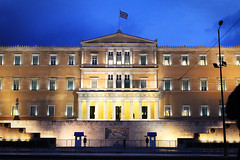
The Greek Parliament voted to lift immunity from prosecution for three of its members, including Golden Dawn (Chryssi Avgi) MP Constantinos Barbaroussis for his part in destroying the stalls of the foreign street market vendors in the town of Messolonghi. According to the state news agency the other two MPs for which immunity was lifted were Christos Kellas of New Democracy and Georgios Lambroulis of the Communist Party of Greece (KKE), whose cases were found to be unrelated to their political or parliamentary status or activities. It voted against lifting immunity for PASOK MP Leonidas Grigorakos by 196 votes against, 23 in favour and one blank vote.
October 19, 2012
FYROM Riot Police Attack Serbian Sports Fans For Raising Greek Flag (VIDEO)
The scenes that were recorded on camera at a FYROM sports event can only be described as SHAMEFUL. A match -we are guessing basketball- between FYROM and Serbia ended in total chaos. As seen in the video, the Serbian supporters have been isolated in one part of the gymnasium. At about 1.30 into the video, one supporter unfolds a Greek flag and begins waving it in the air. Maybe this supporter was a Greek-Serb, or maybe just a friend of Greece (this we do not know). Almost immediately the crowd on the other side of the arena - we are guessing FYROManians- begin hissing and booing the site of the Greek flag and then the unexplainable happened. Masked men suddenly appeared from out of no where and began brutally assaulting the Serbian supporters, especially the young sports fan who was holding up the Greek flag. Aside from taking down the site of the flag, their brutality almost caused a human stampede. We know that the Serbs support our national issues, because our cultures and beliefs are very similar, but in this case maybe the Serbian sports fan just wanted to provoke FYROManian sentiment by showing the Greek flag, since Greece and FYROM are in dispute over the issue of the name. This is not the right approach in our opinion, because as viewed in the video, it can seriously open a very dangerous can of worms. We believe history and diplomacy are still key. Nonetheless, it is not a reason to suddenly unleash a band of terror on a group of sports fans from men who hide behind masks just because you don't like the site of a flag either! If they were offended by the flag, they should have approached the supporter and simply asked him to lower it. Why the violence? Shame... These types of scenes in FYROM definitely prove that this country is close-minded, and lacks in civility!
fyrom - SRBIJA 16.10.2012. από citrusblack83
The Definition Of An Educated Man According To Socrates

According to Socrates its not about the accumulation of knowledge. Wisdom and knowledge, according to him, are matters of behavior.
These include:
- Those who control unpleasant situations, instead of being controlled by them
- Those who treat all events with bravery and good old common sense
- Those who are honest in all their dealings
- Those who face unpleasant situations and are calm even when mistreated by people who dislike them
- Those who can control their pleasures
- Those who were not defeated by their misfortunes and failures
- And Those who do not become arrogant and corrupt by their success and glory
Socrates seems to say that the educated have an even greater responsibility in society. According to him, an educated man has a responsibility to remedy the shortcomings of society when he or she sees them.
We personally admire his nobility, his integrity, his ethical consistency, but sometimes we wonder if his wisdom can be adopted by the present world. What we mean to say is that how many of us would have abandoned rational argument for any kind of argument that could beat the rap?
Unfortunately many of us would.
But if we were better educated, in accordance to what Socrates taught us, then we would know that an educated person has a commitment to the rational process of finding truth, and a commitment to self-examination and articulation of truth. And this person would be a hypocrite if he/she abandoned those commitments for convenience's sake.
The aims of education as derived from Socratic thought are:
- Self-knowledge. The educated man is wise when he knows himself.
- Individual Moral Good. The acquisition of knowledge is valuable for man because it makes him virtuous and happy. Socrates repudiated any ornamental theory of knowledge. In similar fashion Socrates would deplore the use of knowledge merely for material success in life. Knowledge is ethically and morally important for all men.
- Skill in Thinking. Each man must develop his skill in critically appraising propositions through the reasoning process.
We here at HellasFrappe also want to add a few more characteristics to Socrates' list, from our own perspective:
- An educated person must also be a persuasive leader (teacher/great mind)
- An educated person must also be an intellectual, (open mind, open to instruction)
- An educated person must also be committed to the systematic pursuit of the truth. (truth seeker)
- An educated person must also be completely and utterly devoted to a set of principles and defend them at all times (steadfast, consistent, systematic)
- An educated person must also act with integrity and defend his beliefs, even if these beliefs prove to be inconvenient. (well-read, be able to debate calmly and with confidence)
Editor's Note - Without a doubt Socrates remains the paradigm of a brilliant mind that also had courage and character. He was, and forever will be, an ideal for philosophers that will never be matched.

Megaphones And Bullhorns - Another Greek Invention!
 |
| Recent Purchase: Megaphone (Photo credit: LarimdaME) |
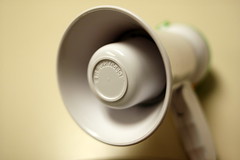
During the days of Socrates and Plato, ancient Greeks developed this means of communication in order to provide the rulers with a manner of delivering mass reports. The earliest written record of the word "megaphone" dates back to Thomas Edison's invention of the modern megaphone in 1878. It is believed that Edison himself coined the term from the Greek megas "great" and phone "voice".
Far before Edison's invention, the idea of the megaphone had existed as early as 6th century BC in Greek amphitheatres, where actors wore masks with large mouth openings for amplification. Sailors, hunters, and military commanders had also used primitive forms of the megaphone since ancient times to communicate longer distances
The Greeks were pretty fascinated with issues of creative thinking. This provided them with diverse methods of creation of various channels of communication.
The bullhorn was cone sharped. At one end was the cone shape with which the sound was intensified before leaving. At the other end was the mouthpiece which functioned as the amplifier of the voice. The sound of the speaker was intensified in the mouth piece as they said phrases within the speaker.
The Greeks raised animals to supply them with diverse items required. The bulls provided them with the horns from which the instruments of communication will be chiseled. The bullhorn was firstly presented but later on was changed by the megaphone for state-of-the-art sound quality. These pieces of equipment were branded by the scholars who were experts in labeling.
Community services were entrusted to the rulers. All the managing work remained with the rulers. Any notices were carried out by the same people. Communicating management concerns by the chiefs and kings were dealt with by using the communication tools created. Boosting of sound meant that they were clear enough to be observed all over the place. The communal improvement was highlighted in the kind of correspondence by these leaders.
People of ancient Greece were likewise gifted actors. The actors were looked upon as the role models of the majority of communities. A lot of acting centered on numerous matters that impacted the community. Communication was of great importance. The celebrities used these tools and the remainder of Greece obtained the craft from the stars.
The bullhorns & megaphones served as the groundwork for development of advanced communication instruments. They served as the basis of improvement of other instruments. With time, the tools progressed into the contemporary instruments utilized for mass announcements. These could certainly adjust the sound levels to be able to obtain specific amplification. Megaphones & bullhorns provided the system of development of communication sector. Advanced communication devices developed from the fundamental tools. Modern piece of equipment have been designed gradually from these units. Amplification of authentic ideas had to transverse different decades and societies during the last hundreds of years.
References
- http://www.ehow.com/about_5063561_megaphones.html
- http://en.wikipedia.org/wiki/Megaphone
- http://www.ehow.com/about_6712038_history-megaphone.html
- http://www.helium.com/items/1891207-history-of-the-megaphone
- http://www.articlesnatch.com/Article/Bullhorn-Megaphone-And-Horn-Speaker/1481395#.UIADBmd5HeQ
Subscribe to:
Posts (Atom)



 Posts
Posts


