Pages

October 19, 2012

, ,

Top 10 Most Influential Whistleblowers of All Time


The subject of insiders -- or "whistleblowers" -- is somewhat tricky; anyone on the inside is often presumed to be compromised by their former allegiance. Nonetheless, the nature of government work is rooted in compartmentalization. So, perhaps the best indication as to whether whistleblowers have something valid to say is the level of persecution they have endured. The following whistleblowers have endured a varying degree of pushback from the system, but are still around to reveal key points of information that make us all question what we are being told by our government and the corporate media. Please listen to the video presentations of the following insiders who have used their positions to educate those on the outside about the machinations of people far more devious than ourselves. These whistleblowers are not the criminals that the U.S. government increasingly charges them as. Rather, these whistleblowers represent the highest level of activism and courage.


1Jesselyn Radack
Jesselyn Radack --  Radack is a former ethics attorney and adviser to the Justice Department. She had been presented with the first case of a detainee in Afghanistan following 9/11. That detainee was John Walker Lindh, an American citizen labeled "The American Taliban." Lindh was set to be interrogated (tortured) without council. Her advice not to pursue that direction went unheeded to the point where her e-mails to the court were deleted, which she had to then resurrect from her computer and present to the media. She subsequently was put on the No-Fly list and was targeted for investigation. Rather than fold, she fought back and wound up going to work for the premier whistleblowing advocacy group, the Government Accountability Project at whistleblower.org, founded in 1977. After everything we have come to know about the torture apparatus overseas, and the subsequent arrival of that apparatus onto American shores embodied in the NDAA, Radack's work is more important than ever. She discusses in the video below her background and the intensified war on whistleblowers.


2Thomas Drake (NSA)
Thomas Drake (NSA) -- The world got an historical overview that shed quite a bit of light on the NSA through a former ABC News reporter, James Bamford, when he released two books The Puzzle Palace and Body of Secrets, which lifted the veil and revealed a massive spying structure that far surpasses the capabilities of the CIA. The apparatus Bamford revealed was comprised of programs like Echelon that were suspected of not only massive international spying and data collection, but also domestic operations. Now those suspicions are being confirmed by high-level insiders such as Thomas Drake, who appeared in a Baltimore Sun article that highlighted a $1.2 billion program called "Trailblazer" which Drake submitted was a program of "fraud, waste, and abuse." He was subsequently charged under The Espionage Act and was facing 35 years in prison. Drake's defense team actually hired James Bamford as an expert witness. The case for 10 felony charges against Drake could not stand up, and he reached a misdemeanor plea deal.  Drake was the first to come forward under a new climate of aggressive formal indictment for whistleblowers that equates their truth-telling with real espionage such as selling state secrets.


3William Binney (NSA)
William Binney (NSA) Former top NSA mathematician and code breaker, William Binney, has gone on record to publicly reveal the scope of a top-secret surveillance program that has directly targeted everyday Americans following 9/11. He is sounding an alarm about the massive scope of this project that engages in 24/7 warrantless wiretapping of the American population. Thomas Drake's testimony was revealing, but Binney was a 32-year, top-level veteran of the NSA who reveals in the video below the domestic component of a program code named "Stellar Wind." With the NSA working to complete its $2 billion fortress of surveillance by September 2013, which can store 100 years worth of electronic information, Binney's concerns that we are heading down the road to totalitarianism ring true.


4Mark Klein (AT&T)
Mark Klein (AT&T) A veteran of twenty-two years as an AT&T technician, Mark Klein left no doubt about the veracity of an NSA domestic spying program when he revealed how he found secret rooms at a switching center in San Francisco. And he had the documents and blueprints to prove it:
    Klein says he collected 120 pages of technical documents left around the San Francisco office showing how the NSA was installing 'splitters' that would allow it to copy both domestic and international Internet traffic moving through AT&T connections with 16 other trunk lines. 'It’s gobs and gobs of information going across the Internet,' Klein says. President Bush has acknowledged he authorized the NSA to intercept the communications of people with known links to terrorist organizations 'into or out of the United States,' but that 'we’re not trolling through the personal lives of millions of innocent Americans.' Intelligence experts say the NSA has the means to filter out suspect communications with sophisticated machines that spot key words, names, addresses or patterns. Eventually, Klein says he decided to take his documents to the Los Angeles Times, to blow the whistle on what he calls 'an illegal and Orwellian project.' (Source)
Yet, the LA Times' editor Dean Baquet killed the story after speaking with Director of National Intelligence John Negroponte and Director of the NSA Gen. Michael Hayden. The story later appeared at the New York Times. Mark Klein recounts his version of events below and how he came to realize that he was "being forced to connect the Big Brother machine." It is worth noting that the Electronic Frontier Foundation has spearheaded lawsuits to reveal just what is being done to the American people, but courts recently ruled that warrantless wiretapping can continue.


5Sibel Edmonds (FBI / 9/11)
Sibel Edmonds (FBI / 9/11) In the wake of 9/11, Edmonds was enlisted as a translator in the FBI language division to interpret wiretaps conducted inside the United States, having been born in Turkey and speaking several key languages. She describes the language division as "the highest security unit in the FBI." She has since become the most classified woman in history, and her efforts to uncover FBI criminality that included, "money laundering, narcotic activities, and nuclear black market converg(ing) with terrorist activities" led her to be pursued and persecuted to an incredible degree by the Justice Department under John Ashcroft and Robert Mueller invoking "state secrets." Her story is harrowing, to say the least; however, she sparked serious doubts among the general population regarding the 9/11 Commission Report -- and she hasn't stopped. To get a glimpse of the energy and tenacity of Sibel Edmonds, see the video trailer below for the whistleblower documentary "Kill The Messenger" which can be viewed in 5 parts starting HERE. More of her work can be found at Boiling Frogs. She also set up the National Security Whisleblower Coalition. And what is The American-Turkish council?


6Susan Lindauer (CIA / 9/11)
Susan Lindauer (CIA / 9/11) Susan was a former CIA asset who worked with the Libyan and Iraqi embassies prior to 9/11. Following that day, she began to reveal CIA complicity in Middle East heroin trafficking.
    Lindauer also talked candidly about how Israel tried to buy U.S. Intelligence officers and Assets. For the first time on record, she revealed that a known Mossad agent tried to bribe her into handing over Iraq’s collection of banking records on Al Qaeda’s financial pipeline by phoning her home in Maryland while she was traveling in Baghdad, and promising to deliver a suitcase full of cash to any city in the world in exchange for the papers. (Source)
Susan subsequently became the second non-Arab citizen to be arrested under the Patriot Act, which culminated in a five-year indictment and near total prison lockdown for one year.

    While in prison Susan was subjected to harsh conditions that would be considered torture in multiple countries. Contrary to what most Americans think, Susan and the other inmates in solitary confinement were only allowed outside once every TEN days and even then the actual amount of time outside was closer to thirty minutes. (Source)
In the video below she discusses her revelations about pre-9/11 warnings and all that followed, which eventually got published in her book Extreme Prejudice: The Terrifying Story of  the Patriot Act and the Cover-ups of 9/11 and Iraq.


7Col. Anthony Shaffer (US Military)
Col. Anthony Shaffer (Military) -- Shaffer is an intelligence agent who claimed that there was deliberate stonewalling of information prior to 9/11 as part of what came to be known as Able Danger. Beyond that, he revealed a culture of infighting between intelligence agencies that, even taken at face value, is concerning for the American taxpayer. Shaffer published his account in Operation Dark Heart. The Department of Defense responded by purchasing the book's first, uncensored, 10,000 copy print run (with U.S. taxpayer dollars, by the way). He might have had something important to say. The video below touches upon what that might have been.


8Joe Banister (IRS)
Joe Banister (IRS) -- In our article 10 Ways to Stop Being a Slave and Bring Down The Pyramids of Control, IRS resistance was presented last. Here are the questions we asked:
    How can a machine be built without the funding to build it?  The entire prison system we see around us has been built with our own money. Did you authorize it? Did you authorize the preemptive wars, bank bailouts, corporate subsidies, the high-tech surveillance grid that enslaves you?
Special agent, Joe Banister, exposed the mechanics of what the IRS is and how fundamentally illegal and unconstitutional their tax collection policies and methods are. The system came down HARD on one of its own. His story is instrumental in understanding what happened to the next IRS whistleblower, Sherry Peel Jackson, who took exposure to a whole new level and was pursued ruthlessly for her revelations. The income tax we have been told to believe is a patriotic obligation is itself a complete fraud. The current tax code is 72,000 pages. It is complicated for a reason. If we can wake up to the foundations of this nightmare coercive system, we stand a great chance of restoring power into the hands of the people instead of a tiny few at the top of the pyramid. Caution is warranted, however: the IRS is ready, willing and able to lock you up for a longer term than human trafficking and child porn. So, proceed with caution, but keep courage close at hand.


9Bradley Manning  (Military)
Bradley Manning  (Military) allegedly transmitted state secrets to WikiLeaks:
    Manning was arrested at forward operating base Hammer outside Baghdad on 27 May 2010 on suspicion of being the source of the biggest leak of confidential state documents in US history. He faces 22 charges relating to the transferal of hundreds of thousands of diplomatic cables, videos and war logs to the whistleblowing website.
    Under the US military rule book, a soldier must be arraigned and his trial officially started within 120 days of him being put into captivity. (...)
    Should the trial kick off on 4 February next year, as it is currently scheduled to do, he will have been held for 983 days. (Source)
Bradley Manning's case and treatment is at the heart of a new U.S. government mission that equates the revealing of truth as aiding an abetting the enemy, which should serve as an indictment upon the system which pursues truth-tellers like Manning so vehemently. He only sought to expose the horrific "collateral damage" of the war in which he was enlisted, which has been properly retitled into "Collateral Murder." Due to his total lockdown, there is no video we can present of Bradley Manning speaking for himself, but the video he brought out to the public through WikiLeaks says it all:


10Julian Assange and WikiLeaks
Julian Assange and WikiLeaks -- Assange is in a category all his own due to heading up the whistleblower repository of WikiLeaks. It has been argued that Assange and WikiLeaks are controlled opposition, much the same as Anonymous; or is it just a global chess game?  Given the subsequent persecution of Assange that continues on without relent by the establishment, he seems to have more likely been a patsy who has served to demonize all manner of whistleblowing and intimidate anyone who would take center stage in an effort to bolster people such as those documented above. Very well-respected alternative news voices such as Max Keiser and Paul Craig Roberts insist that Assange is legitimate and should be given the Nobel Peace Prize rather than warmongers and corporate financiers.

Despite whistleblowers' explosive disclosures, the surveillance state has been normalized, as the House has voted to reauthorize the 2008 FISA Amendment Act. And, sadly, many whistleblowers who might have had even more to say have been assassinated by the system they were employed to serve. That alone should serve as a warning to those who have chosen to enter such employment, knowing the level of evil they contract with. The control structure is massive, and growing, so we must listen to the voices who courageously come forth to issue their concerns, especially when those of good conscience are being persecuted as never before.

(source - Activist Post)

October 18, 2012

,

CHRIS SPIROU TO ROMNEY: “Stop offending Greece and the Greek people!”

Mitt Romney in 2007 in Washington, DC at the V...
Mitt Romney  (credit: Wikipedia)
In a blistering open letter to Mitt Romney, Republican candidate for president of the United States, former New Hampshire Democratic Leader Chris Spirou tells Romney to “stop condemning and using Greece as an example, every time you went to deflect the domestic economic debate in the Presidential Campaign”.

Romney on five different occasions this year in campaign speeches compared President Obama’s domestic fiscal policies to those of Greece.

In a CNN Live event aired in Cincinnati, Ohio, on September 1st, Mitt Romney said: “You are not going to get entrepreneurs and businesses of all kinds to invest in Ohio and invest in our other states in America, put their life savings to work here, unless they know that they are not headed to the place Greece is in.”

Spirou a Greek American and a long time political leader in the state of New Hampshire in his letter asks Romney:

“Why did you choose to pick on Greece and its citizens, Mr. Romney? What is your obsession with Greece? You know well, that similar, if not worse governmental economic crises exist today in many other countries in Europe. Countries such as Spain, Portugal, Italy, Ireland and other European nations have faced and are facing huge governmental economic difficulties, many beyond their citizens’ ability to handle.”

“Tell us, Mr. Romney, why do the current governmental budgetary difficulties of Greece stand out for you? Is it because you are afraid to compare President Obama’s successful economic policies of the past three and a half (3 ½) years with the disastrous domestic economic policies he inherited from your political hero, President George W. Bush.”

And Spirou continues: “Let me ask you, Mr. Romney. Did the political leaders of Greece hand over to President Obama in 2008 an economically destroyed America? Is that what you are trying to imply in your statements?”

“Did the governments of Greece and the Greek citizens cause America’s economic meltdown in 2000-2008, Mr. Romney? Did the domestic economic policies of the governments of Greece cause nearly twenty (20) million Americans to go on the unemployment lines and the soup kitchen rolls?”

“Were the governmental economic policies of Greece, responsible for the disintegration of one of the largest banks in the United States, Lehman Brothers, which caused economic destruction in America, not seen in our country since the 1920s, Mr. Romney?”

“Tell us Mr. Romney. Greece and its citizens caused the auto industry in America to go out of business? You recall America’s auto industry, Mr. Romney, don’t you? That’s the auto industry, which in 2009 you said «let it go bankrupt».”

“Let the auto industry go “bankrupt” is what your solution was in 2009, Mr. Romney. Let the auto industry go “bankrupt”, while hundreds of thousands of our fellow hardworking Americans were losing their jobs, their homes, their investments, their savings, their families and many their lives.”

“Mr. Romney, I don’t know what is the cause of your obsession with Greece and the Greek people, other than seemingly basic racist tendencies. I want to remind you however, that the Greek nation and the Greek people have been staunch friends and allies of the United States through thick and thin. And we, Greek Americans have been true American citizens second to none.”

Mr. Spirou concludes by saying: “Mr. Romney, it looks as though, one of your biggest concerns, as a candidate for President is that with Barack Obama president, America will end up having the same domestic economic problems as Greece is having. Well, let me tell you, Mr. Romney, what the biggest concern most of us, Greek Americans who will vote come November, 6, have. We are concerned and we are scared that with Mitt Romney president, our beloved America will end up having a second domestic economic meltdown, similar to the meltdown our country experienced under President George W. Bush.”

“Mr. Romney, we don’t want to return again to the days of George W. Bush. The eight years of George Bush’s presidency and the days he left behind were a thousand times worse for America and its people, than the problems Greece and its citizens are going through these days.”

Chris Spirou was New Hampshire’s House Democratic Leader, Democratic Party Chairman and Democratic nominee for governor.

Hellenic News of America

Enhanced by Zemanta
,

BREAKING NEWS - Violent Clashes Brake Out At Anti-Austerity Demonstration

credit iefimerida
Violent clashes have broken out at the anti-austerity demonstration in central Athens, during a 24-hour general strike. Reports are saying that provocateurs are pelting riot police with Molotov bombs and rocks. On their part the Greek riot police is responding with tear gas to disperse the troublemakers.

According to unconfirmed reports, a 67 year-old an unemployed sailor who participated in PAME's (Greek Communist Party's union) march died, after falling ill during the demonstration. The man was immediately rushed to the Evangelismos Hospital where despite all efforts, doctors were not able to keep him alive.


,

Investigation Into Ben Needham Disappearance Focus Of Visit By UK Officials To Kos


Almost two decades ago, little Ben Needham was abducted -or suddenly went missing- on the island of Kos and the incident became one of the longest-running missing person’s cases in British history. Recently, British police officers investigating the case, flew to the island to continue the search.

Ben Needham vanished on the island in 1991. Despite several possible sightings and theories about what happened, there's been no trace of him. Officers from South Yorkshire will use specialist equipment to examine a mound of earth at the property where he went missing. Ben's mother Kerry believes her son was abducted and is still alive - she says this latest development is part of an elimination process.

A team of experts will begin examining the grounds of the farmhouse from which Ben disappeared tomorrow, before deciding whether any areas should be dug up. The search, which is expected to last up to 10 days, will centre on a large mound near the house which is now grassed over.

One theory is that Ben could have been buried beneath building material which was dumped there at the time he went missing.

His mother, Kerry Needham, 41, told the Daily Mirror: "This is an elimination process and that's how I'm dealing with it. "It's one of the most important things to happen in 21 years."

Mrs Needham has previously said she believes the mound was already there when Ben went missing.

Angela Smith, the MP for Penistone and Stocksbridge, told BBC Radio Sheffield: "Hopefully they won't find Ben in that rubble and it closes down another line of inquiry and narrows down the possibilities. "I know that she [Mrs Needham] will be very keen for this work to be undertaken and rock solid confident, I'm sure, that they won't find Ben there."

Towards the end of January, Hellasfrappe had featured a story about this case, as well as had announced the news that Hollywood actor Tom Cruise is getting ready to shoot a film on the Greek island centered around Ben's story.

Moved by the incident, Tom Cruise helped spread the word of Ben’s disappearance recently by sending tweets to millions of followers. Others followed including singer Boy George and actress Jennifer Saunders. As a result of the celebrity involvement,  Scottish Television (STV) and ITV Calendar both did a story on Ben. Also many UK Tabloid newspapers also ran the story.

We have posted a picture of Ben from the website his parents set up for his search showing how he would look today, but if you want to know more on what happened to Ben and read the timeline, then simply visit http://www.helpfindben.co.uk
,

GREEK INNOVATION - Greek Engineer Creates First Ever Solar Elevator (VIDEO)


Greek engineer Yiannis Sachsamanoglou and his  team have managed to develop the technology required for a home elevator to function  at a low cost on solar energy. Their project was chosen by the European Commission to be the Greek entry in the EU Climate Campaign for 2012. Sachsamanoglou, who got the idea of a solar lift from his young daughter, says that creating an adequate photovoltaic system is not difficult per se; the real challenge was making it cost effective. The team achieved this after four years of  extensive research, hoping that the cost will further decrease when a mass scale production of solar lifts creates  economies of scale.

The solar elevator has very low power consumption (about 80% less than conventional lifts) and works with batteries which are charged using solar power -for three days- or, on a cloudy day, single-phase electric power. This way, the lift is functional even during a power cut, earthquake or fire, so there is no chance for users to be trapped in the cabin.

With the latest safety measures and compliance certification, this is a lift that not only satisfies people's mobility needs, it also leaves a greener environment.
, ,

Illuminati Sex Practices - Strauss-Kahn's Life Was "Out of Step" but Not Illegal

Dominique Strauss-Kahn bat le bitume
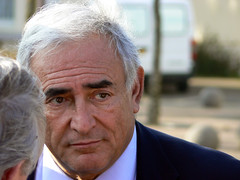
Dominique Strauss-Kahn (Photo credit: bixintx)
"The investigation into the prostitution ring in Lille ultimately swept up 10 suspects, including [former IMF Chief] Mr. Strauss-Kahn. They knew each other largely through their membership as French Freemasons."

By D. Carvajal and Maia de la Baume
(New York Times, abridged by henrymakow.com)

PARIS -- More than a year after resigning in disgrace as the managing director of the International Monetary Fund (IMF), Dominique Strauss-Kahn is pursuing a uniquely French legal defense to settle a criminal inquiry that exposed his hidden life as a libertine. Strauss-Kahn, 63, a silver-haired economist, is seeking to throw out criminal charges in an inquiry into ties to a prostitution ring in northern France with the legal argument that the authorities are unfairly trying to "criminalize lust."

That defense and the investigation, which is facing a critical judicial hearing in late November, have offered a keyhole view into a clandestine practice in certain powerful circles of French society: secret soirees with lawyers, judges, police officials, journalists and musicians that start with a fine meal and end with naked guests and public sex with multiple partners.

In France, "Libertinage" has a long history in the culture, dating from a 16th-century religious sect of libertines. But the most perplexing question in the Strauss-Kahn affair is how a career politician with ambition to lead one of Europe's most powerful nations was blinded to the possibility that his zest for sex parties could present a liability, or risk blackmail.

The exclusive orgies called "parties fines" -- lavish Champagne affairs costing around $13,000 each -- were organized as a roving international circuit from Paris to Washington by businessmen seeking to ingratiate themselves with Mr. Strauss-Kahn. Some of that money, according to a lawyer for the main host, ultimately paid for prostitutes because of a shortage of women at the mixed soirees orchestrated largely for the benefit of Mr. Strauss-Kahn, who sometimes sought sex with three or four women.

Last week, Strauss-Kahn broke a long silence to acknowledge that perhaps his double life as an unrestrained libertine was a little outré. "I long thought that I could lead my life as I wanted," he said in an interview with the French magazine Le Point. "And that includes free behavior between consenting adults. There are numerous parties that exist like this in Paris, and you would be surprised to encounter certain people. I was naïve. I was too out of step with French society," he added. "I was wrong."

ORGIES

Mr. Strauss-Kahn's name first surfaced in the French inquiry by chance, in May 2011. French investigators were tapping the telephones of Dominique Alderweireld, an owner of Belgian sex clubs who is also a suspect in the prostitution ring. In one conversation between Mr. Alderweireld and a longtime childhood friend, René Kojfer, who worked at the Carlton Hotel in Lille, the men were gossiping about Mr. Strauss-Kahn's recent New York arrest, according to lawyers involved in the case.

They then recalled a freewheeling luncheon in 2009 at a Paris restaurant called L'Aventure, and Mr. Kojfer discussed whether they could make money by offering information about that day to Ms. Diallo's lawyer, Mr. Thompson, who was never called, the lawyers said. At L'Aventure, Mr. Strauss-Kahn and a few friends gathered in a private basement club, carpeted in purple and black tiger stripes, with a female Belgian escort and Mr. Alderweireld's companion, Béatrice Legrain, who recalled that lunch in an interview.

She said that Mr. Strauss-Kahn, energized by Viagra, had sex with the escort and then followed Ms. Legrain to the bathroom, grabbing her and demanding sex. But she said she rebuffed him and it "wasn't a big deal." Mr. Strauss-Kahn's lawyer declined to comment. In his own interview, Mr. Alderweireld made light of the "petit" episode at L'Aventure. His lawyer, Sorin Margulis, took a more scornful view: "It's more an act of Louis XIV."

FREEMASONRY

The investigation into the prostitution ring in Lille ultimately swept up 10 suspects, including Mr. Strauss-Kahn. They knew each other largely through their membership as French Freemasons, according to Karl Vandamme, a defense lawyer who represents Fabrice Paszkowski, the owner of a medical supply company who played a crucial role in organizing the sex parties. "Libertines are people like you and me: people who have a normal life," said Mr. Vandamme, who said his client invested around $65,000 in party expenses, betting on the political rise of Mr. Strauss-Kahn.

The banker, he said, would typically arrive late for the more than a dozen parties, held over a period of about five years. There was a rhythm to the gatherings, with everyone dressed for a sit-down dinner, he said. Then over time, couples separated, "kisses were exchanged between one woman and another and between a husband and the wife of a friend" until the guests "all ended up nude."

Mr. Strauss-Kahn's double life is not surprising to some Parisians."He's not the only libertine man in the political world," said Olivia Cattan, who leads an anti-sexism association called Words of Women and believes the case reflects a code of silence. "It is linked to power, and women are often complicit when it can guarantee them a job."

, , ,

WELCOME TO MANI And The Cave in Bay of Diros (VIDEOS)

English: Mani - Hellas - Greece
Mani - Greece (Photo credit: Wikipedia)
When planning to tour the southern Peloponnese, and specifically Mani, keep in mind that this journey is not for timid or easy travelers or for those seeking idyllic, digestible landscapes. It is rather for all of those who love the unique and challenging landscape leaving the rest to be squeezed in the islands.

Mani, the southernmost and middle peninsula of the Peloponnese or Morea, straddling the districts of Lakonia and Messenia in southern Greece, is a treasure trove of Byzantine and post Byzantine churches, Frankish castles and stunning scenery. The isolated aspect of this beautiful -yet mysterious- area, combined with the independent nature of its inhabitants meant that some traditions developed separately from the rest of the Peloponnese and Greece so that a distinct society made its mark on the landscape. To this day the architecture of the area is famed for the tower houses and fortified family dwellings from the period of the Ottoman occupation of Greece.

This region's coastal villages are adorned with cafes and souvenir shops and some popular beaches during the summer include Kalogria and the Stoupa harbor, while Kardamyli and Agios Nikolaos have nice pebble and sand beaches too. The ancient tower houses of Mani (pyrgospita) are significant tourist attractions, and some even offer accommodation for visitors.

But certainly the star attraction , aside from Mystras (which is close by) is the beautiful and mysterious Diros Caves. The Diros Caves are located approximately 12 miles south of Areopolis and they are part of an underground river. Archaeological research has shown that the caves have served as places of worship in Paleolithic and Neolithic times and their inhabitant believed that the caves were the entrance to the Underworld

The cave is essentially divided into three caves and stretches 14 km, the tourist route, however, has a total length of 1,500 meters. The temperature of the caves, continually ranges between 17-19° (at all times), and boat tours usually last for about half an hour.

About 5,000 meters have been exposed and are accessible by small boats and through narrow passageways.

Snow-white columns rising from the water, stalactites and stalagmites playing in tones of pink and elsewhere red, have given the names to the separate rooms: the Pillars of Hercules, the Lake Okeanidon, Palm Trees, the Chapel, the Stone Flower, the Pink Salons, Velvet Stalactites, the Lighthouse, Golden Rain, the Sea of Wreckage, the Chocolate Room, the Spider’s Net, the Cave of Bethlehem, the Flying Saucer, the Hall of Lovers, the Lake with Fairies are some of those encountered in the path.

Reproduction of the paleo-environment of western Mani after the Pleistocene period and its interaction with man, the realization of a systematic surface study of the environs of the Bay of Diros and the study and publication of the archaeological material unearthed were the three targets of the research programme "Diros excavation and research project" that was completed over the summer.

The Alepotrypa (Foxhole) Cave, the exploration of which began in 1970, was inhabited during the Neolithic Period (6000-3000B C) and has produced thousands of finds of clay, stone and bone tools, jewelry and human and animal bones. The 2012 studies began with a geoscopic study in the area of Xagounaki (Neolithic acropolis of Diros) at the northern entrance of the Alepotrypa Cave. This area gave up a heavy concentration of stone tools, shells and human bones from the Late Neolithic Period.

Excavations also turned up an undisturbed double child burial in an urn, sections of another burial from the Final Neolithic Period and three adult burials, also undisturbed. The concentration of the more than 160 burials found to date, combined with the large quantity of pottery and tool finds, lead to the conclusion that the area was heavily occupied during the Final Neolithic Period.

Noteworthy is the full absence of finds after the Neolithic Period, which indicates that the Cave and its surrounding area were not used after that period for systematic habitation.

Overlooking the Bay of Diros, Alepotrypa is a stalactitic cave that contains the remains of a Neolithic (Stone Age) village, burials, a lake and an amphitheater-sized final chamber that hosted burial rituals more than 5,000 years ago.

The Cave was sealed off from the outside world during a heavy earthquake at the end of the Late Neolithic Period, until it was accidentally discovered by locals in 1958. (Combined Reports, gogreece, AMNA, YouTube)

WELCOME TO MANI
,

SHOCKING - 100,000 Greek Businesses Have Closed Down In Less Than 3 Years

ATHENS, GREECE - MAY 29:  A woman passes a clo...
ATHENS, GREECE - MAY 29: A woman passes a closed shop in the city centre on May 29, 2011 (Image credit: Getty Images via @daylife)

The General Confederation of Professional Handicraftsmen and Merchants of Greece (GSEVEE) has addressed a letter to Prime Minister Antonis Samaras and the party leaders, calling for a meeting with them. According to the letter, "the figures from Eurostat show that the vicious circle of recession is threatening the endurance of society, the viability of businesses and is leading to the mass ruin of jobs and it does not allow government and party isolationism and unilateral decisions."

GSEVEE also pointed out that "the policy of internal devaluation, also according to data of GSEVEE, has led 100,000 businesses (net decrease) to a discontinuation of work over the past 2.5 years. Data that is also confirmed by Eurostat".

As regards jobs, about 500,000 have been lost in the private sector from 2010 until today, resulting in the economic crisis tending to turn into an intensively humanitarian one as well. The private sector and small businesses in particular have 'kneeled'".

More than 90,000 small and average-size (SMEs) Greek businesses were obliged to close down from 2008 until 2011, with predictions for this year remaining ominous. This data is included in the results of a performance evaluation report achieved by SMEs in all EU member-states, that was prepared by the European Commission.  (AMNA)

October 17, 2012

, , , , ,

SHAMEFUL - Angelopoulos Family Declares Villa As Shopping Mall To Pay Less In Taxes, Electricity

photo credit - protothema
The family of (her royal highness) Gianna Angelopoulos -one of the wealthiest families in Greece- has apparently registered their luxury villa in the elite Athens suburb of Paleo Psychico as a shopping centre so that they can pay less in property taxes, but also in electricity consumption, according to the chairman of the union of employees in the Greek electricity company (DEH) Nikos Fotopoulos. The unionist, told the proto thema newspaper, that instead of paying for electricity at the prices applicable to all households, the Angelopoulos family has been paying electricity, for their 4,695 square metre villa, at the lower prices determined for shopping centres, dressmaking shops and hospitals.

He also revealed that the villa, known for its lavish parties, was also the scene of a tragedy several years ago when at one party they decided to set off some fireworks and set a fire to a small forest nearby.

Fotopoulos, said that the reason the GENOP-DEH trade unionists confiscated data from the DEH offices last week was to prove how some of the more wealthier families of Greece have been dodging taxes. According to him, the present leader of PASOK Evangelos Venizelos (and the series of laws he adopted while at the Ministry of Finance) allowed people who own big real estate properties to get large discounts in the value of the extra tax.

He then went on to explain. He said that the gap between the rates of electricity prices in the Angelopoulos case is scandalously high. "Things are very simple. The electricity company loses a load of income that it would have received if the rate for household consumption was valid."

Fotopoulos said that electricity consumption for the villa runs at about 50,000 kWh per month, whereas an average household it runs at 1,700 kWh for four months. By taking advantage of the reduced rate, the Angelopoulos family now pays between 0.05 and 0.06 euro per kWh, whereas an average household pays between 0.06 and 0.09 euro per kWh (for the first 2,000 kWh). This means that the loss to the Greek power company DEH (and tax payers pockets) is over 5,000 Euros every four months.

Wait.. there is more.

Thanks to a legal text of the Ministry of Finance that dates back to the time when the current leader of PASOK Evangelos Venizelos headed the Ministry, the Angelopoulos family has also been paying less in property taxes as well. According to Fotopoulos, the real estate tax on non-residential property -in areas of more than 1,000 square metres-  is 30 percent less, while properties over 2,000 square metres have a 60 percent reduction.

This is the loophole (which was probably purposely designed that way by Evangelos the Large to keep his elite friends happy and) which has allowed the Angelopoulos family to save 35,000 Euros per year, or pay a tax of only 51,115 Euros instead of the 86,388 Euros which they would have been obligated to pay had they not lied.

And if you think for a moment that the Angelopoulos case is unique, think again! Authorities are actually investigating 1,750 similar cases, and some are even involve elite families who have not paid a single penny in taxes. Most of these properties are owned by former parliamentarians, civil engineers, very prominent businessmen, as well as lawyers, doctors and those involved in the shipping business.Article in Greek - http://www.protothema.gr/greece/article/?aid=230305

Editor's Note - Gianna Angelopoulos-Daskalaki is a Greek business woman who got angry with the former prime minister of Greece Mr. Costas Karamanlis because she wanted him to make her president of the Republic and did everything in her power -even slam him with the traditional Eleftheros Typos newspaper which she bought and then allowed to bankrupt- in order to discredit him and remove him from power. She is also said to be the force ($$) behind the SYRIZA party and the pro-drachma block in Greece. Also, she is a benefactor at the Harvard Kennedy School, following the steps of yet another "shady" character by the name of S. Kokkalis, where she opened her arms to George Papandreou who is now a Fellow there. Indeed she is best known for being the president of the bidding and organizing committee for the 2004 Summer Olympics in Athens, Greece, as well as one of the 50 most powerful women by Forbes magazine, but let's face it... you can't get on those lists unless you have dabbled in the pie a bit. One day, hopefully in the near future, someone will reveal her skeletons... because we have had had it up to here with her kind, and her wormy methods to rise to power.


, ,

S.LYGEROS - The True State of Greek-Turkish Relations

Συνάντηση Αντιπροέδρου της Κυβέρνησης και ΥΠΕΞ...
(Photo credit: Υπουργείο Εξωτερικών)
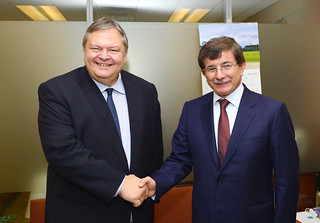
Turkey’s foreign minister Ahmet Davutoglu descended on Greece in 2012 to discuss bilateral issues. The visit took place under the shadow of continuing Turkish violations of Greek airspace and territorial waters; Turkish machinations in Thrace; threats against Cyprus, 37% of which Turkey has occupied since 1974; and Turkey’s policy of destabilising Greece by facilitating the entry of tens of thousands of illegal immigrants into the country. Still, warm words were exchanged by Davutoglu and his Greek interlocutors, with the emphasis on co-operation, a common future and so on. Davutoglu’s reference to the Aegean becoming "free" raised a few Greek eyebrows, implying, as it did, that the sea was currently under occupation or not free; but even this was put down to a figure of speech lost in translation. Anyway, below is a piece from hellenicantidote that was translated from Greek by Stavros Lygeros, which appeared in Greece’s leading newspaper, Kathimerini and evaluates where we really stand with Greek-Turkish relations, beyond the diplomatic speak.

The Other Side to the Visit, by Stavros Lygeros

The headlines may have been stolen during Ahmet Davutoglu’s visit to Athens by his reference to a ‘free’ Aegean, which was attributed to mistranslation, but, as usual, the essence lies elsewhere. We don’t need to tie ourselves in knots trying to decipher what the Turkish foreign minister meant by a ‘free’ Aegean to learn Turkey’s true intentions. Ankara is consistently and clearly projecting its positions and making sure to back up its words with deeds.

The Turkish foreign minister’s rhetoric is a classic case of public diplomacy. He doesn’t confuse foreign policy with public relations. He knows, however, how to use public relations and rhetorical flourishes in pursuit of strategy. Davutoglu wants to convince Greek public opinion that not only does Turkey not pose a threat to Greece, but that Turkey is also sincerely working to extricate bilateral relations from the prejudices of the past.

To overcome Greek skepticism and induce Athens to fall in line behind his strategic vision, Davutoglu is talking up the potential of Turkey and Greece having a common role in the region. But, for Turkey, what this common role entails is turning Greece into a satellite in the Neo-Ottoman orbit. Thus, while Turkish diplomacy cultivates a climate of settling differences, it doesn’t abandon its long-held expansionist designs and provocative actions aimed at Greece.

A typical example is the unilateral and arbitrary delineation of Turkey’s maritime borders in the Eastern Mediterranean. Thus, at the beginning of 2011, Ankara announced its intention to carve out 11 maritime zones totalling an area of 20.000 square kilometers, south, south-east and south-west of Attalia. Some of these ‘zones’ violate the median line principle and penetrate deep into the Greek and Cypriot continental shelves. Also, in April 2011, Turkey published maps in its official gazette that showed clear disregard for the Cypriot and Greek continental shelves, while, in September, Turkey gave substance to its arbitrary decisions by submitting documents to the UN confirming what it perceives to be the delineation of maritime borders and continental shelves in the region.

While Turkey attempts to create faits accompli with arbitrary and unilateral actions, Davutoglu tries to prevent Greece from exercising its legal rights. The Turkish foreign minister expressed to his Greek counterpart Turkey’s opposition to any declaration by Greece of its Exclusive Economic Zone before agreement on the delineation of territorial waters and continental shelves. Thus, Ankara has managed to transform its unilateral claims against Greece into bilateral issues, projecting its threats as a legitimate defence of its rights.

Greece has a legal right to extend its territorial waters to 12 nautical miles and it is a right that can be exercised unilaterally. By insisting that such a declaration would be a cause for war, Ankara has transformed a Greek right into a subject of negotiations. Turkey is trying to do exactly the same on the EEZ issue. Greek foreign minister Dimitris Avraamopoulos must come clean and reveal if it’s true that he told his Turkish counterpart that Greece, for the time being, will not declare its EEZ.

In his discussions with Avraamopoulos, Davutoglu also reiterated Turkey’s position on the exclusion of Kastellorizo from the exploratory talks taking place between Greece and Turkey on maritime borders. Ankara sees Kastellorizo not as the last link in a chain of Greek islands, but as a detached island lying off the Turkish coast.

Turkey insists that Greek islands do not have a continental shelf and, in this way, Ankara reveals its claim to the continental shelf east of the Rhodes-Karpathos-Kassos-Crete line. Indeed, on 13-14 November 2008, Turkey announced that it was undertaking geological surveys south of Kastellorizo. This was a tangible warning to Athens not to declare its EEZ and proceed with its own research. A few days earlier, the then chief of the Turkish navy, Metin Atac, said: ‘I believe that the Eastern Mediterranean will become the scene of friction and clashes, because in the near future it will acquire increasing importance. Its oil deposits will make it a second Gulf, and Turkey must be alert and react.’

Just as in the Aegean, the Turks are using ‘surveys’ and ‘research’ in the Eastern Mediterranean as a means to provoke crises and prevent Greece from exercising its legal rights to explore for hydrocarbons.

Athens fears Turkish research in the Greek continental shelf, a fear that Turkey cultivates with the continuous and intense presence of its airforce and navy in the region, which is intended to show that Turkey has placed under its military control the sea running from Rhodes to Crete and Cyprus. Overall, Turkey’s aim is to oblige Greece to agree to a sharing of deposits or joint exploration – sharing and joint exploration of Greek resources.


,

PROVOCATION - Turkey Alters EU Progress Report Referring to "Ecumenical" Patriarch

His All Holiness Ecumenical Patriarch Bartholo...
His All Holiness Ecumenical Patriarch Bartholomew I (Photo credit: Wikipedia)
The 2012 EU progress report for Turkey makes special reference to Ecumenical Patriarch Bartholomew, specifically noting -- on page 24 -- that "Ecumenical Patriarch Bartholomew celebrated in August, for the third time after almost nine decades the Divine Liturgy of the Dormition of Theotokos at the Sumela Monastery in the Black Sea province of Trabzon..."

However, the Turkish-language translation of the same report, released by Turkey's ministry of European affairs, substitutes "Ecumenical" with the phrase "rum ortodoks Patrii", in other works, the "Greek Orthodox Patriarch".

The alteration in the EU progress report appears to continue an official Turkish state policy of not recognising the Ecumenical Patriarchate as the "Primus inter pares" of Christian Orthodox Patriarchates in the Christian world. (AMNA)

Editor's Note - Obviously not... The EU can try, and try again... When will they realize that when it comes to Turkey, you can't teach an old dog new tricks? These three-piece suit officials from Brussels should really visit a library and begin reading a few history books. Didn't the Ottomans behead and slaughter -in cold blood- our Ecumenical Patriarch in 1453?  They sure as hell did... So what is to stop them from respecting Christianity in this era? E?

, ,

Kaminis Wants To Run Again For Athens Mayor - LOL


He did such a good job the first time (Editor clearing throat) that Athens Mayor George Kaminis announced that he is actually planning to run again for reelection in the 2014 municipal elections. Speaking on the municipal radio station 98.4 in Athens, Kaminis said it was his "duty" to be a candidate again, because he has yet to complete his "mission". He also said that it was his intention to start up a new initiative with the State in order to create a "front", comprised of "democratic forces" (@#!@#@) against the the nationalist Golden Dawn party.

Editor's Note - Trust us Mr. Kaminis... you have completed your mission in the center of Athens. You allowed for the creation of a ghetto and a center for the trade of narcotics and sex. Your advocacy for Third World nationals, destroyed the historical buildings and scenery our capital city was once proud of. And your incompetence and determination to create a home away from home for these illegal immigrants -with the blessings of the George Papandreou government, or PASOK- was indeed successful. Today Athens truly has the look and feel of Kabul or Botswana. Well done! No worries... your job is totally complete here. You destroyed the city and allowed the crime rate to soar. The only thing Athenians will not do is shoot themselves in the head by voting for you again. THAT IS CERTAIN.


Movie Trailer - God Loves Caviar "O Theos agapaei to haviari"

An oil portrait of Varvakis, attributed to Vla...
A portrait of Varvakis  (Photo credit: Wikipedia)
God Loves Caviar is a compelling story of Ioannis Varvakis, and his incredible journey from being a humble Greek pirate to an international caviar millionaire, with the ear of Catherine the Great of Russia. His wealth and power, however, do not give him contentment, and his boundless ambition only brings suffering, until he gives everything away, including himself, in the name of love. This epic tale, based on Varvakis' real life, moves from the Greek island of Psara to the court of Catherine the Great in Russia and the shores of the Caspian Sea, and then back to Greece, a country torn by civil war and the fight for independence, during the Revolution of 1821 against the Ottoman Empire. Varvakis strives all his life for freedom for himself and then for his country, only to find that freedom cannot be won until it is shared.

The movie was directed by Ioannis Smaragdis, who is a Cretan, that now lives in France. He has directed feature films such as Cavafy (1996) and El Greco (2007).

Ioannis Varvakis (1745-1825), also known as Ivan Andreevich Varvatsi was a distinguished member of the Russian and Greek communities. He was a member of the Filiki Eteria and benefactor of the places where he lived. In Greece was, is, and will always be seen as a national hero,

Cast
  • Sebastian Koch - Ioannis Varvakis
  • Evgeniy Stychkin - Ivan
  • Juan Diego Botto - Lefentarios
  • Olga Sutulova - Helena
  • John Cleese - McCormick
  • Catherine Deneuve - Empress Catherine II of Russia
  • Akis Sakellariou - Kimon
  • Alexandra Sakelaropoulou - Varvakis' Mother
  • Fotini Baxevani
  • Lakis Lazopoulos - Fisherman of God
  • Pavlos Kontoyannidis
  • Alexandros Mylonas - Temporary Prime Minister
  • Yannis Vouros - Businessman A


WOMEX - 15 Annual "World Music Expo" Opens In Thessaloniki


The 15th Annual World Music Expo (Womex) is scheduled to begin in Thessaloniki today and run until October 21. Following three successive years in Copenhagen (2009-2011), the Greek northern city is planning to take the lead in what is considered one of the most important international professional market of world music of its kind (UNESCO). Womex brings together professionals from the worlds of folk, roots, ethnic and traditional music.

Moreover, the international fair also contributes to networking as an effective means of promoting music and culture of all kinds across frontiers, and features some 300 artists. More than 2,500 participants are expected to turn up for the event.

Thessaloniki Womex 2012 is supported by the Hellenic Ministry of Culture. Womex will also mark its first participation in Southeastern Europe, and this will give international audience the opportunity to discover Greece and the broader Balkan area through its distinctive musical heritage.


,

Archaeologists Set Out To Uncover Mysteries Of Troy

Portion of the legendary walls of Troy (VII), ...
Portion of the legendary walls of Troy (VII), identified as the site of the Trojan War (ca. 1200 BC) (credit: Wikipedia)

Troy, the palatial city of prehistory, sacked by the Greeks through trickery and a fabled wooden horse, will be excavated anew beginning in 2013 by a cross-disciplinary team of archaeologists and other scientists, it was announced on Monday, Oct. 15. The new expedition will be led by University of Wisconsin-Madison classics Professor William Aylward, an archaeologist with long experience digging in the ruins of classical antiquity, including Troy itself.

The new international project at Troy, to be conducted under the auspices of and in cooperation with Turkey's Çanakkale Onsekiz Mart University, will begin a series of summer-time expeditions beginning in 2013. 

"Troy is a touchstone of Western civilization," says Aylward. "Although the site has been excavated in the past, there is much yet to be discovered. Our plan is to extend work to unexplored areas of the site and to systematically employ new technologies to extract even more information about the people who lived here thousands of years ago."

Troy and the Trojan War were immortalized in Homer's epic poem the Iliad centuries after the supposed events of the conflict. The site was occupied almost continuously for about 4,500 years, from the beginning of the Bronze Age to the 13th century A.D., when it was abandoned and consigned to myth. It was rediscovered in the 1870s by the wealthy German businessman and pioneering archaeologist Heinrich Schliemann whose work at Troy laid the foundations for modern archaeology. 

"Our goal is to add a new layer of information to what we already know about Troy," says Aylward, who is contributing an international team of archaeologists and scientists to conduct what promises to be the most comprehensive dig since Troy's discovery over 140 years ago. "The archaeological record is rich. If we take a closer look with new scientific tools for study of ancient biological and cultural environments, there is much to be found for telling the story of this world heritage site."

The site of Troy is in modern Turkey and is situated on the Dardanelles, a crossroads between East and West and a flashpoint for conflict in both ancient and modern times. The archaeological site is a complex layer cake of history and prehistory, with 10 cities superimposed one atop the other, some with clear evidence for violent destruction.

Following the demise of Troy at the end of the Bronze Age, the site was re-settled by Greeks, Romans and others, who all claimed Homer's Troy and its cast of characters – Achilles, Helen, Patroclus, Priam and Ajax – as their own cultural heritage. The ancient city was visited by the Persian general Xerxes, Alexander the Great, and Roman emperors, including Augustus and Hadrian. Homer's epic poems about a lost age of heroes and the legendary Trojan War have endured as sources of inspiration for art and literature ever since.

Although archaeologists have been digging at Troy for almost 140 years, with the exception of a 50-year hiatus between 1938 and 1988, less than one-fifth of the site has been scientifically excavated. With about 4,500 years of nearly uninterrupted settlement at a crossroads between Europe and Asia, Troy is fundamental for questions about the development of civilization in Europe and the Near East. "Troy deserves a world-class archaeological program," says Aylward.

In its heyday, Troy's citadel, with walls 12 feet thick and more than 30 feet high, was about 6 acres in size. A walled lower town covered an expanse of 50 acres, much of which is unexplored. Mysteries abound. Ancient Troy's royal cemetery, for example, has yet to be discovered and archaeologists are eager to add to the single example of prehistoric writing known from Troy, a small bronze seal from the Bronze Age. 

"Major gaps in our knowledge involve the identity of the prehistoric Trojans, the location of their principal cemeteries and the nature of their writing system," says Aylward. "The enduring question of the historicity of the Trojan War is also worthy of further exploration."

In future work at Troy, Aylward plans an array of collaborations in order to deploy powerful new scientific techniques to reveal the hidden record of the ancient city and its inhabitants. New methods to examine chemical residues on pottery from ancient kitchens and banquet halls, for example, may reveal secrets of ancient Trojan culinary proclivities, and genomic analyses of human and animal remains may shed light on diseases and afflictions at a crossroads of civilization.

Much of the new work in the area of "molecular archaeology," which includes DNA sequencing and protein analysis, will be conducted in collaboration with the UW-Madison Biotechnology Center, which has become an active partner in the new Troy project. This past summer, researchers from the center participated in reconnaissance for future studies.

The new Wisconsin expedition to Troy builds on years of existing work and international collaboration at the site. The new program to be inaugurated in 2013 will be conducted under the auspices of Çanakkale Onsekiz Mart University, which is situated near the site of Troy.

Reference - Terry Devitt - trdevitt@wisc.edu

Enhanced by Zemanta

October 16, 2012

, , ,

Russian Soldiers Want To Parade Alongside Greek Marines on OXI Day


Russia has formally asked to parade alongside Greek soldiers in the military parade on October 28, or OXI Day, which is traditionally held in Thessaloniki every year. According to reports, the contingent which made the request is from a group of marines from the Russian apobatic "Novotserkask" of the Black Sea Fleet, which consists of about 350 Marines, etc. It is actually the same contingent that marched alongside  Greek soldiers in Limnos several weeks ago, and was received with great enthusiasm from the residents there.

The ship is scheduled to be near the northern Greek city between the 26 to 29 of October. Currently the Russians are waiting to see if their request will be accepted by the Greek State.

If the State allows them to join in on the festivities, and if they actually do march alongside Greek marines in next week's parade, it will have immense geopolitical importance for our country as well as send many messages to our (so-called) neighbor Turkey.

Interestingly, Russian marines, or Russian soldiers are very well liked in Greece. Another reason northern Greeks like the Russians -even though this is not related to the parade- is because the presidency of their prized team PAOK was taken over earlier this year by former Greek-Russian parliamentarian and businessman Ivan Savvides. From what it looks like he has taken the team to a whole different level and it is actually performing really well. (SOURCE: defencenet)

Whoever Enters Greece Illegally Will Now Be Detained For One Year!


FINALLY some good news. Up until recently, Greek authorities were only permitted to detain immigrants who entered our country illegally for no more than six months. If during this period, they presented some sort of documentation, they were allowed to leave the detention centers and roam freely across Greece (for a certain time period). Unfortunately, and for reasons which are obvious, many reports claim that most of the illegal immigrants would tear up their formal documents, so that Greek authorities could not register their information properly in fear of being caught and deported.

Well, this is about to change. A new Presidential Decree, which was considered legitimate by the State Council, is expected to deter the entry of illegal immigrants to Greece, because now if they do not have the necessary supporting documents they will automatically be detained in various detention centers across the country for one whole year!

The The Presidential concerns "uniform procedures for identification to aliens and stateless refugee status or subsidiary protection in compliance with Directive 2005/85/EC on minimum standards on procedures in Member States for granting and withdrawing refugee status. "

The one year gives authorities plenty of time to prepare the necessary paperwork to either deport these people back to their countries of origin, or to grant them asylum. 

Article in Greek on protothema

,

Greek Ambassador To US - A new beginning for Greece

This photograph depicts the Embassy of Greece ...
Embassy of Greece in the US, (Photo credit: Wikipedia)
Christos Panagopoulos is ambassador of Greece to the United States.

(GREEK AMERICAN NEWS AGENCY) - Although I just arrived in Washington, D.C., as the new Greek ambassador, America makes me feel right at home. This is not only because I have served in the United States twice in my career ― in Boston and in Los Angeles ― but also because there are so many things here that remind me of my home country’s heritage and radiant culture, bringing out the deep affinities of our two nations, our shared values and our strong ties of friendship and alliance.

The Capitol building, with its neoclassical architecture, the themes of the Federalist Papers and the works of the Founding Fathers of America ― all can find many of their roots in Hellenism. The Hellenic spirit has always transcended its geographic borders ― not just in antiquity, but through the Hellenistic era, the Byzantine Empire, the Age of Enlightenment and onwards.

Our destinies have always been intertwined, from the admiration of the Greek people for this nation’s own struggle for independence to the American people’s support for our War of Independence, and the solidarity to the outnumbered Greek Army’s stand against the Axis forces, which resulted in the first Allied victory in WWII. We have fought side by side throughout all the major conflicts in the 20th century, and your famed Liberty ships launched the modern Greek shipping industry. Our mutual history is also linked by the long presence of the Greek American community: a community that came to America in times of hardship and has managed to thrive and excel through hard work, commitment and dedication to their new homeland.

My arrival in America coincides with Greece’s severe economic crisis and our efforts to implement long-overdue reform. This has deeply affected the Greek people: it has led to a dramatic drop in their standard of living, which was never nearly as high as that in other Western European nations.
We are indeed grateful for the support of our European partners, the U.S. and the international community. This support is not free: it comes in the form of loans that we are paying back with interest; it comes at a cost to everyday people, as we are pushing through painful reforms; and it comes as a response to a crisis that is not just Greek or even just European.

To paraphrase John Donne, “No economy is an island.” In this global economy, our fates are intertwined. However, Greece offers the West an island of stability in a volatile and crisis-stricken region. Understanding this, we take our responsibilities very seriously, implementing drastic measures that no other modern country has taken in such a short period of time. We are also making great strides in an ambitious privatization plan, and doing a great deal to attract foreign investment.

Fiscal crisis aside, Greece is a country of many treasures: its sun-kissed beauty, its rich history and culture, and its Mediterranean climate that yields agricultural products of exquisite quality make it unique. Greece offers well developed tourism, shipping, and service industries; a highly skilled and hard-working labor force; natural resources; and above all, the perpetual will of its people to succeed.
Despite the crisis at hand, Greece is proactively pursuing its foreign policy objectives. Focusing on our region, we are striving to bring the countries of Southeast Europe into the Euro-Atlantic family, on the condition that they meet the necessary criteria and respect the principle of good neighborly relations. Just a few days ago, the Turkish foreign minister visited Athens. We still have pending issues, but we maintain close and regular consultations, trying to find common ground. Also, the Albanian foreign minister paid a visit, after we signed, along with Italy, a Memorandum of Understanding (MOU) for the construction of the Trans Adriatic Pipeline (TAP), to promote energy security in Europe. We have proposed to the former Yugoslav Republic of Macedonia that we sign an MOU to facilitate the resolution of the name issue, trying to break the deadlock caused by Skopje’s lack of any constructive step since the U.N. talks began almost 20 years ago.

In the swiftly changing region of the Middle East and North Africa, we maintain close contacts with the countries in democratic transition, including Egypt, and we are closely monitoring the deteriorating situation in Syria. We are enhancing our cooperation with Israel, to the benefit of stability in the wider Eastern Mediterranean.

Greece has a proven record as a steady and reliable ally that provides critical support to NATO. For example, Greece is taking part in the operation in Afghanistan and provided vital logistical support to the operation in Libya. In the true spirit of cooperation, we are committed to working with you to promote peace and stability, remembering that both countries have given the world democracy, freedom and the inherent value of the individual. I look forward to our future together.
, ,

Archaic Greek And Islamized Greeks of Black Sea (VIDEOS) - MUST WATCH


An endangered Greek dialect which is spoken in north-eastern Turkey has been identified by researchers as a "linguistic goldmine" because of its startling closeness to the ancient language, as Cambridge researcher Dr Ioanna Sitaridou explains.

Wikipedia says that the Archaic period in Greece (800 BC – 480 BC) was a period of ancient Greek history that followed the Greek Dark Ages. This period saw the rise of the polis and the founding of colonies, as well as the first inklings of classical philosophy, theatre in the form of tragedies performed during Dionysia, and written poetry, which appeared with the reintroduction of the written language, lost during the Greek Dark Ages. The term archaic covers these cultural aspects as well.

The termini of the Archaic period are defined as the "structural revolution", meaning a sudden upsurge of population and material goods that occurred c. 750 BC, and the "intellectual revolution" of classical Greece. The end of archaism is conventionally marked by Xerxes' invasion of Greece in 480 BC.

The sharp rise in population at the start of the Archaic period brought with it the settlement of new towns and the expansion of the older population centres. The Archaic period is also characterized by the spread of colonization along the Mediterranean and Black Sea coasts that began about 800 B.C. The reason for this phenomenon is described by Greek authors as stenochoria, or "the lack of land", but in practice it was caused by a great number of reasons, such as rivalry between political groups, a desire for adventure, expatriation, the search for trade opportunities, etc

Here is a great investigative report that was conducted by SKAI channel's Neoi Fakeloi several years ago titled the "Islamized" Greeks of the Black Sea". You will be surprised to discover how many Greek people still live in northern Turkey. Unfortunately these people were forced to embrace Islam, but according to many recent reports they are crypto-Christians. These people were also prohibited from speaking Greek and according to what is stated in this video -from the various interviews made- Turkey's "Grey Wolves" (a radical nationalist and dangerous group) has also forbidden students in this area to speak with the Pontian dialect which is an ancient Greek dialect, or else... (but this never stopped any Greek. it's in the DNA).

So, when Turkish officials come to Greece to feed us rhetoric about strengthening relations between our countries, or when the provocative Turkish Consulate in Komotini begins talking about oppressed Turkish minorities in the region of Thrace -who are fortunate because  at least they have the freedom to speak any language they choose- HellasFrappe will once again PUBLISH THIS VIDEO to remind our neighbors across the sea that at least Greece respects human rights... And that Turkey should do the same.

Finally, this video is dedicated to all the "Ellinarades" who play Turkish shows all day long on their television networks in a ploy to Turkify the Greek population. The people of this video are living proof that they cannot do that, because even though they were oppressed, forbidden to speak their language and even practise their true religion, they have never forgotten 400 years of Ottoman rule and what it means to be a slave and still say they are Greek!


, ,

SPIEGEL - Debt Crisis Forces Greeks To Seek Calm in Mt. Athos Monasteries

English: Orthodox monk in the Vatopedi monaste...
English: Orthodox monk in the Vatopedi monastery, Mount Athos. (Photo credit: Wikipedia)
A great report was posted in Germany's Spiegel by Daniel Steinvorth on Mount Athos. It says that this self-governed peninsula in northeastern Greece, has been attracting pilgrims to its Orthodox monasteries for centuries. But the debt crisis has led to a sharp rise in the number of guests seeking calm and solace there.
Daniel Steinvorth
Spiegel

"Mornings on the sacred mountain begin with loud blows. A monk stands in front of the monastery church of Agiou Andrea and hammers a block of wood. The medieval percussion instrument, called a simantron, is the wakeup call for the first religious service of the day. Several black-clad, bearded men scurry across the courtyard. It is 4 a.m. and pitch-black, and the air is filled with the sound of cicadas.

In a few minutes, the oil lamps will be lit in Agiou Andrea, one of 12 “sketes,” or monastic communities, on Mount Athos. There’s not a single empty space in the choir benches. Sitting behind the singing, rhythmically chanting monks are pilgrims from Greece, Russia and Romania. They have slept a few hours on spartan beds, gone without electricity and warm water, and spent the night swatting at mosquitoes.

Agiou Andrea is not a place to expect luxury. But no one has come here for that. “I am here to wash myself clean of my sins,” says Ilie, a young Romanian who lives in Germany. “Here, we are closer to heaven than anywhere else.” Nikos, a Greek businessman, has come to the monastery to find himself. “To simply turn off, meditate and forget the material world,” he says.

The “Holy Mountain” of Athos is a special place for Orthodox Christians. The sparsely inhabited third finger of the Halkidiki Peninsula in northeastern Greece is wildly beautiful, with almost 350 square kilometres (135 square miles) of dense forests and hills. Legend has it that the Virgin Mary landed here on her way to Cyprus and was overcome by its beauty. God then gave her the mountain on it as a gift. And since the “Garden of the Virgin Mary,” as the place is known, is devoted to only the “purest of all women,” other women are not allowed in. At least that is the reason given by the monks who have ruled Athos as an autonomous monastic republic since the 10th century. Not even female animals are allowed on Athos, except cats.


Living By the Julian Calendar

Whenever European Union officials argue that the ban should be lifted, the monks point to a Byzantine document over 1,000 years old that promises them eternal sovereignty over Mount Athos. The men there take no orders from the outside world — especially not from the EU. The monks live in another era. They continue to revere and invoke the names of Byzantine emperors, and they still live by the Julian calendar. In Dafni, the only port, the banner of the Byzantine Empire, which came to an end 559 years ago, flies alongside the Greek flag.

It is this defiant renunciation of the outside world that fascinates many pilgrims. But recently it hasn’t just been the pious who are coming. Many Greeks have discovered Athos as a place where they can forget about the crisis.

The monks have been reporting the biggest influx of visitors in years. Those who can get a visa to Athos, known as a diamonitirion, entitling them to a stay of four days at most, can count themselves lucky.

Ilie, the Romanian, has gotten a special permit. He wants to stay there for at least three months. To get it he registered as a volunteer at Agiou Andrea, where he helps out in the kitchen and laundry room. He says there is no greater joy for him than to be allowed to make himself useful in the holiest place on Earth. “Most Christians in the West do not take religion very seriously,” he says. “They don’t believe with their whole heart.” The crusades, the plundering of Constantinople and the attacks on Orthodox monasteries may have happened centuries ago, he adds, but it remains seared into the historical memory of the monks.

Many monks, Ilie warns, are therefore suspicious of non-Orthodox foreigners. But they aren’t the only outsiders in question. Lately, Greek politicians aren’t very welcome either, mainly because of the property scandal that engulfed the Vatopedi monastery several years ago. In late 2005, the head of the monastery, Abbot Efraim, reached a dubious deal with the government led by then-Prime Minister Costas Karamanlis: A lake in northeastern Greece that supposedly belonged to the Vatopedi monastery (proven with Byzantine documents, naturally) was swapped for valuable government-owned buildings.

Air and Water Turned Into Gold

The abbot wanted money for the land, but the prospect of setting up a lucrative real estate empire appealed to him as well. The sale of the buildings earned the monastery some €100 million ($129 million). Abbot Efraim, newspapers later wrote, had performed the feat of transforming “air and water into pure gold.”

The scandal led to the resignation of two members of the government, and Karamanlis had to call a new election. Efraim was arrested in December 2011, to the outrage of the monks. The real culprits, they said, were in Athens. “There are many bad people who want to blame the padres,” is all Ilie wants to say about the affair. Like many pilgrims, he isn’t interested in politics. In any case, Ilie says he wanted to serve God in the austerest environment. And Vatopedi, one of the wealthiest of the monasteries, doesn’t fall into that category.

Dawn is breaking over the church of Agiou Andrea. The morning service lasts almost two hours, and visitors have to wait until it’s over to get a simple breakfast. They have to stick to the rules, and breathing in a lot of incense on an empty stomach is just one of them. Ilie shows how to make the sign of the cross properly and how to kiss glass-encased icons while still drowsy with sleep without banging your head. “That constantly happens to me,” he says with a smile.

After breakfast, the pilgrims bid farewell. The monks allow only one night’s stay in each of the monasteries. The pilgrims walk to the next one, past hills and through valleys covered with olive trees and orchards. The landscape shimmers in silence. The entire setting is perfectly peaceful.
The articles posted on HellasFrappe are for entertainment and education purposes only. The views expressed here are solely those of the contributing author and do not necessarily reflect the views of HellasFrappe. Our blog believes in free speech and does not warrant the content on this site. You use the information at your own risk.